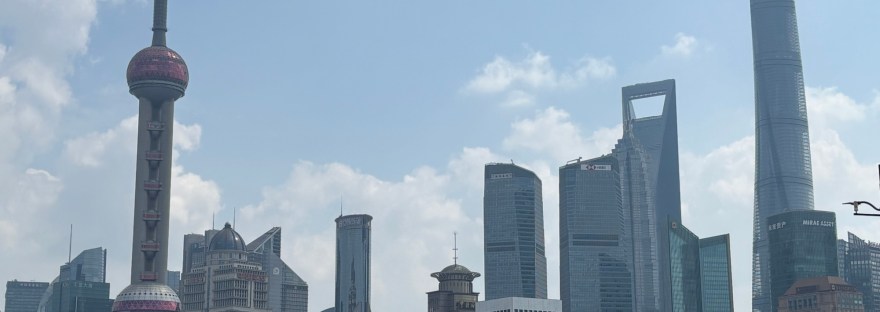
Today’s first order of business was simple enough: walk the length of East Nanjing Road to the Bund!
Our hotel is ideally situated for this task, right on People’s Square, so just walking out onto the street and turning a left set us right on the very beginning of East Nanjing Road, Shanghai’s main commercial avenue.
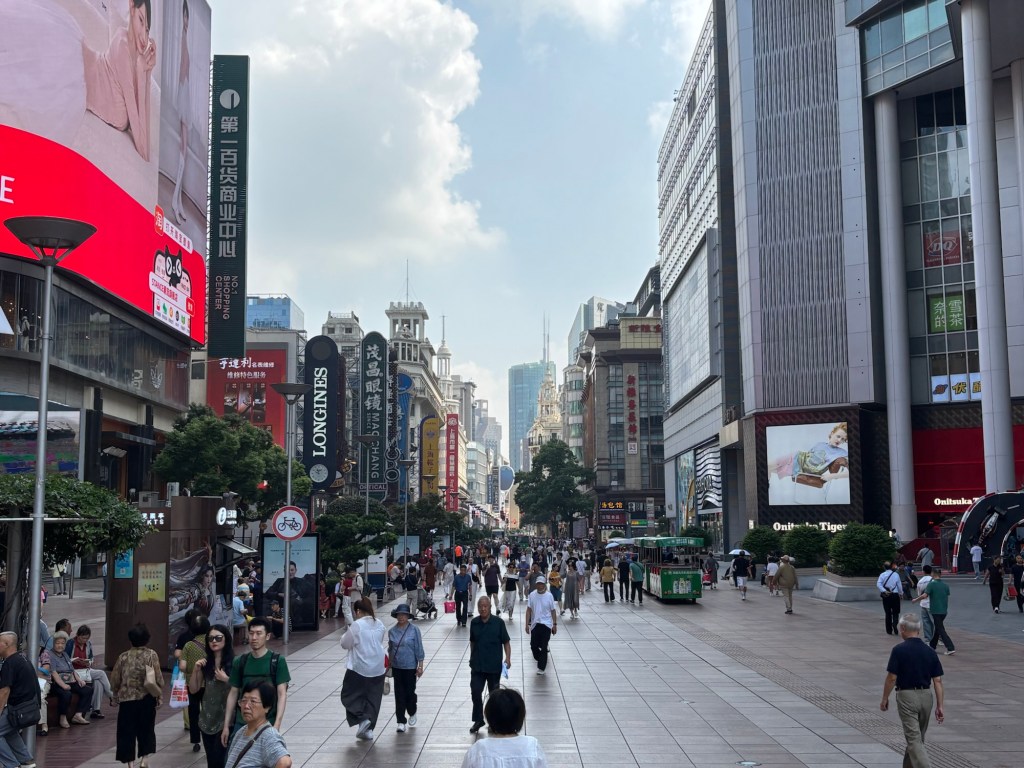
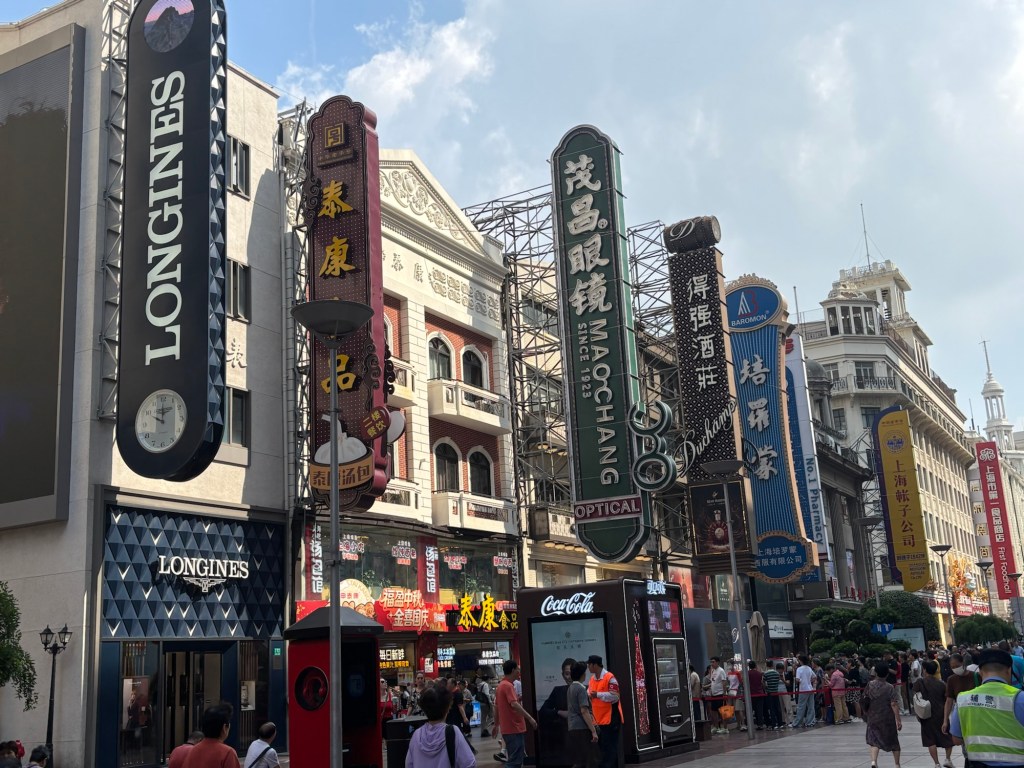
At 10 in the morning it made for a very entertaining walk, although one in which the shops were the least important element: for me it was all about architecture (Chinese style buildings, 1930s art deco, contemporary glass structures, all mixed together) and people-watching (families taking pictures of each other, Western couples, Chinese tour groups…). At this time the street was a lot less crowded than I’ve seen in pictures, but there were still lines out of every street food place. Were people lining up for breakfast? Brunch? A mysterious third thing?
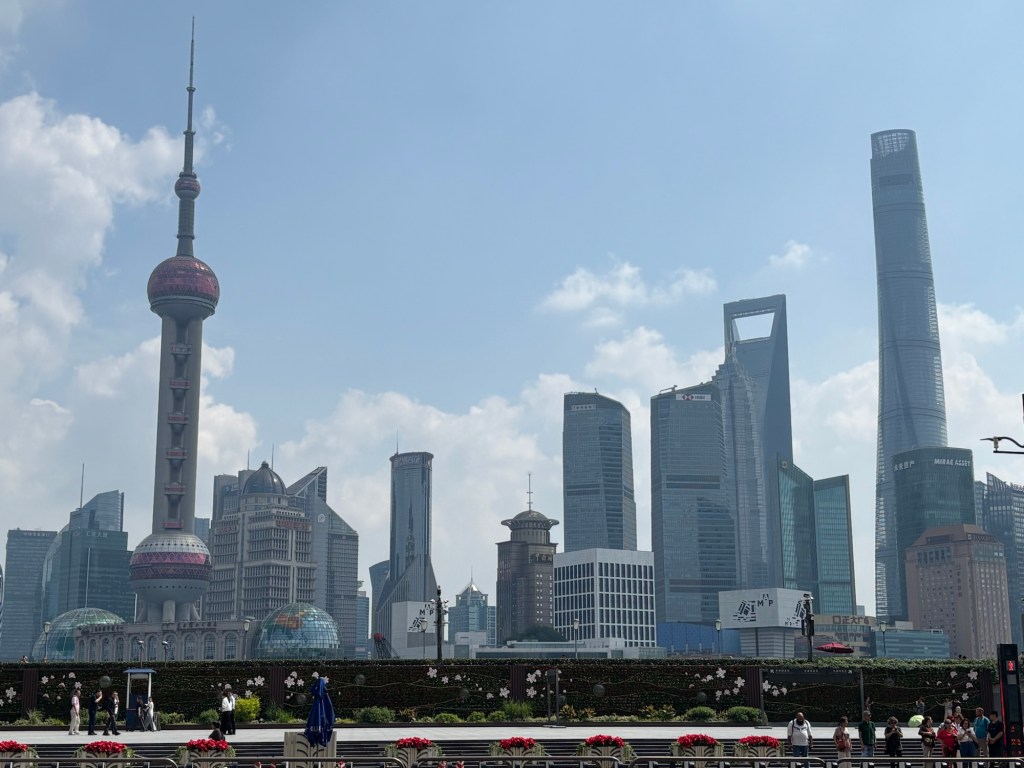
The goal was to walk along Nanjing Road all the way until it runs into the Huangpu River and becomes The Bund, the riverside promenade that runs north to south. Here is where you can see the iconic view of the Pudong skyline that is so representative of Shanghai, most notably with the Oriental Pearl Tower and its strange, alien-looking burgundy spheres. You’ll have to take my word for it, but it feels so much bigger in person than it does in pictures. It dwarfs every other skyscraper in the skyline, I think it has to do with the scale or the proportions of the design more than the size itself.
While on the Bund, it’s important to also look at this side of the road, because there are a lot of important buildings from the 1920s and 30s that stand basically untouched since then, like the Bank of China, or the Fairmont Peace Hotel, where we ducked for a moment for an outrageously expensive coffee break. Before I came on this trip a friend told me there are two currencies in China, the yuan and the Shanghai yuan, and she couldn’t be more right!
Once rested (…a little), we took a short walk north to Yuanmingyuan Road, because I’d read it had interesting indie stores, but was disappointed to find a very pretty but tiny pedestrian street with only a couple of minimalist, comically overpriced apparel stores. Skip!
So we took the metro to go to Yuyuan, a district built around the eponymous gardens.
I knew that Yuyuan Garden was adjacent to the Yuyuan Bazaar, but I had assumed the latter would be yet another commercial old street just like the ones we’ve seen in every other city so far, but I was shocked to find a full open-air mall all built like big, traditional Chinese houses, teeming with people.
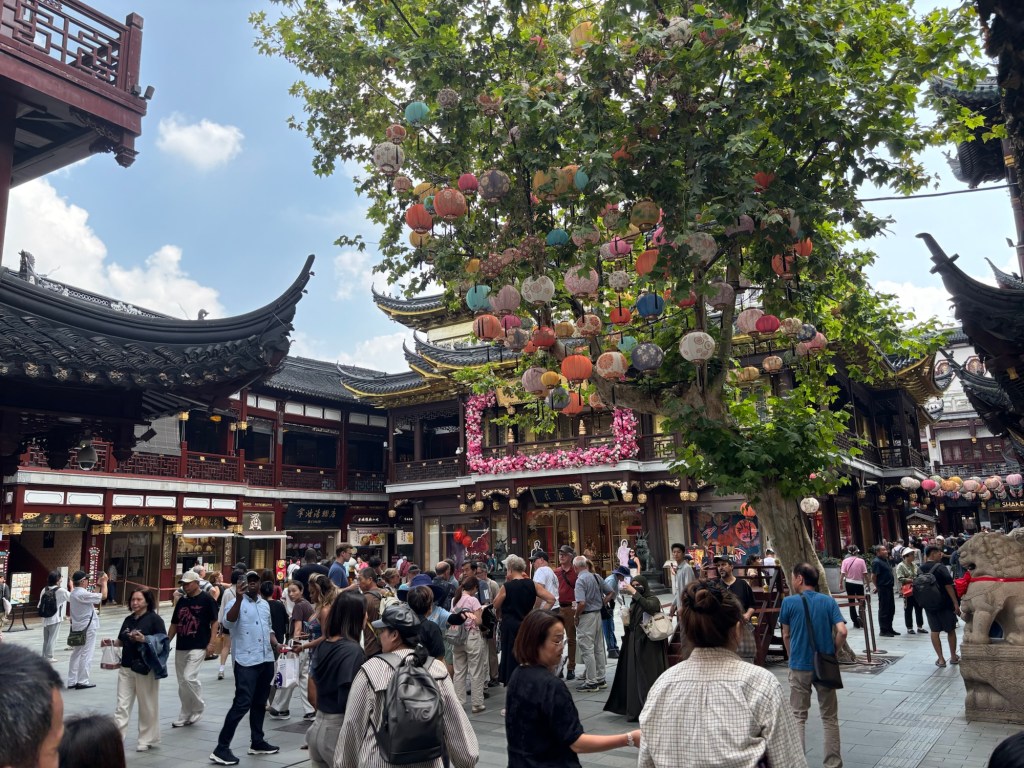
My plan was to have lunch before proceeding with the visit to the gardens, and I had selected Nanxiang Steamed Bun Restaurant, recommended by my guidebook and sitting right there in the center of the bazaar area, right next to the characteristic Huxin Teahouse and its zigzagging bridges over the pond (this is because the ancient Chinese believed ghosts could only travel in a straight line, so the zigzagging bridges would thwart them).
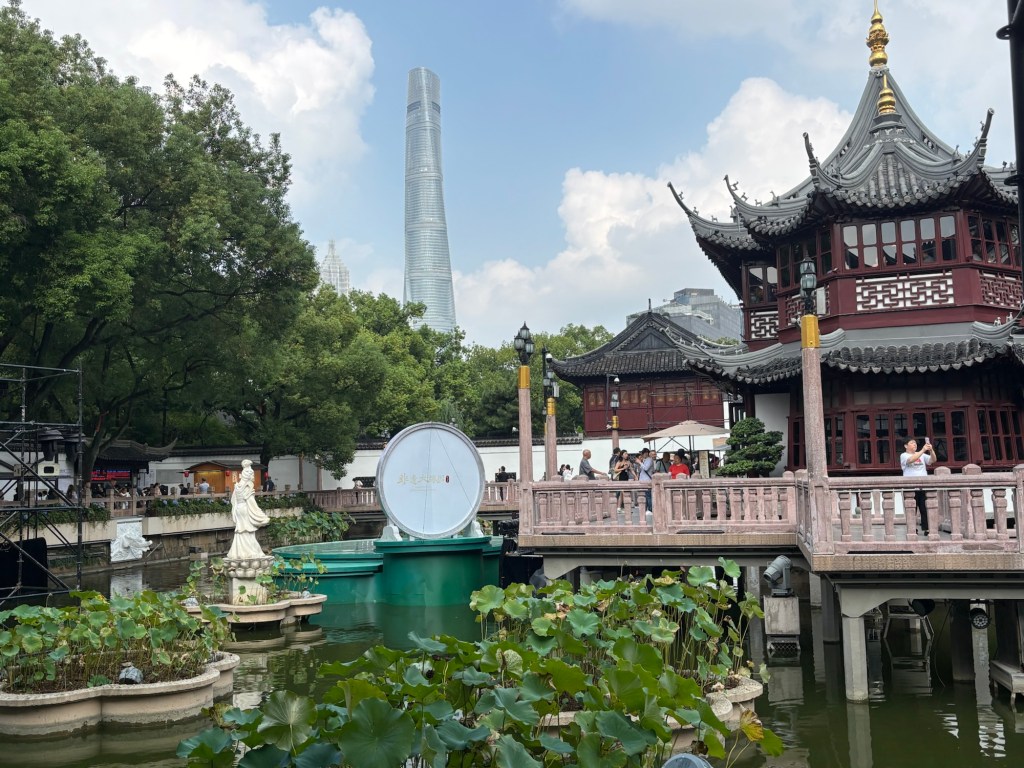
The problem, of course, was that seeing the millions of people going in every direction I was beginning to fear that we would find a long wait at the restaurant and face the fight-or-flight dilemma of whether to wait or go someplace else, and sure enough when we got there there was a queue of ten or so people. But, as it’s been the case at every other restaurant with a waiting list, no sooner had we sat down than they waved all of us in! I must have a bodhisattva looking out for me because how can I be so lucky?
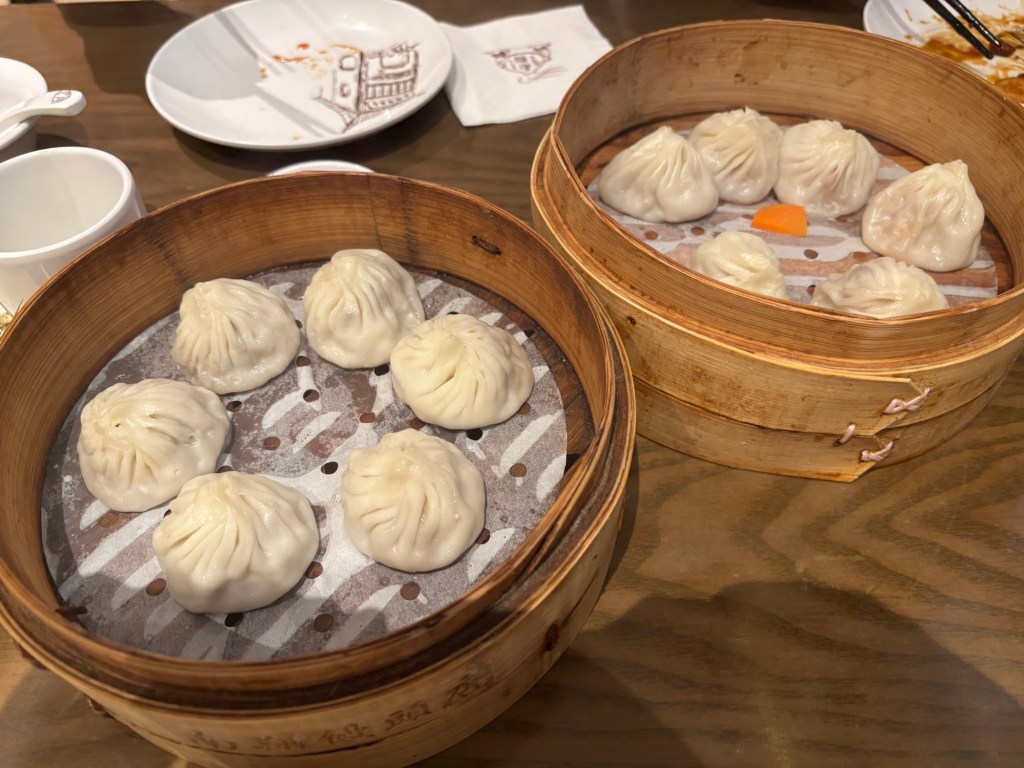
Nanxiang specializes in xiaolongbao, or small dumplings, Shanghai’s star specialty, so I knew I couldn’t leave China without trying them at least once. I ordered some with pork and others with pork and mushrooms. They came in baskets of six, and from watching videos I already knew to take one, place it on a spoon over a plate, then bite into it preparing for some hot soup to spill out. They were delicious, if perhaps not terribly flavorful; Shanghai cuisine is very different from Sichuan cuisine! For that matter, the cuisines of the four regions of China we have visited have clearly distinct flavor profiles, and discovering their unique qualities has been one of the great pleasures of this trip.
Anyway, after a hearty lunch, we cross the Teahouse bridges (advantages of being alive) and walked into Yuyuan Gardens, the whole reason all of us were there!
This garden was built by a rich family in the 16th century (!), but I read that it was destroyed during later wars and reconstructed as recently as the 1960s. While I can’t vouch for its historical accuracy, I can definitely recommend a visit because it’s a lovely place!
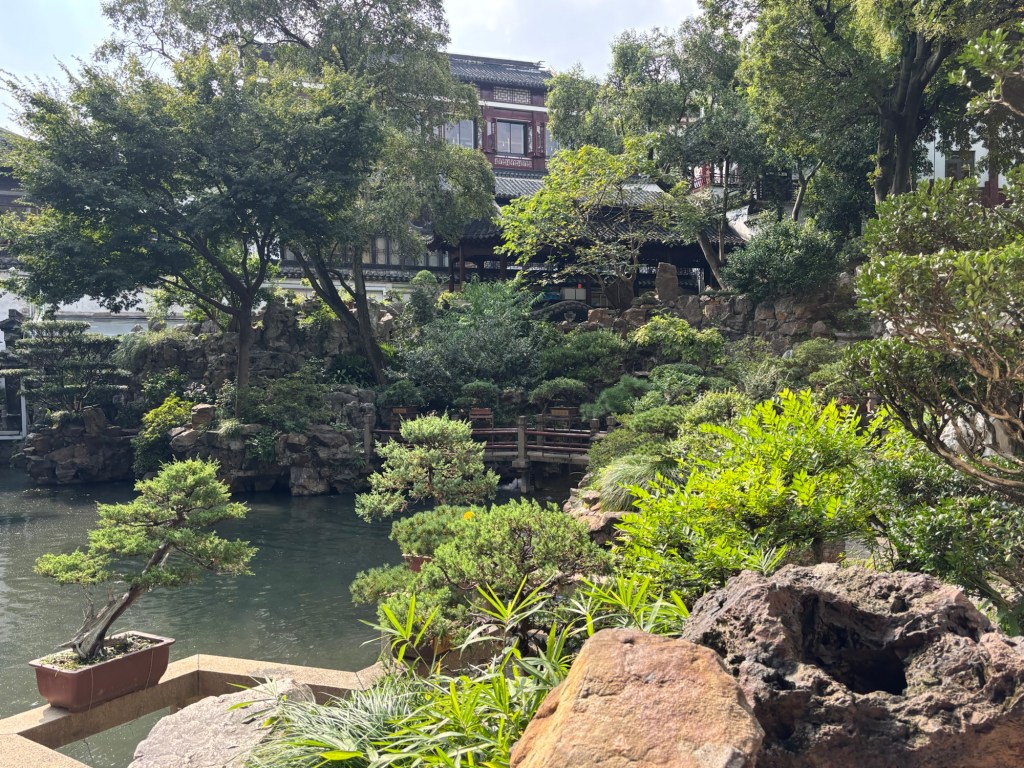
At about three in the afternoon, it was pretty crowded, but by this point in the trip I’ve developed a sort of selective blindness to crowds, so I wasn’t bothered -I’m not even trying to take pictures without people in them anymore. Enjoy the photos full of strangers!
While being distinctly Chinese, Yuyuan reminded me of Japanese gardens in that they share one quality that makes me love them so much more than French gardens, which is breaking down the space into many differently themed sections. Here, I would turn a corner and see a beautiful bridge over a pond, then turn right to see a bonsai garden, then turn again and find a pavilion where one might perhaps entertain guests…
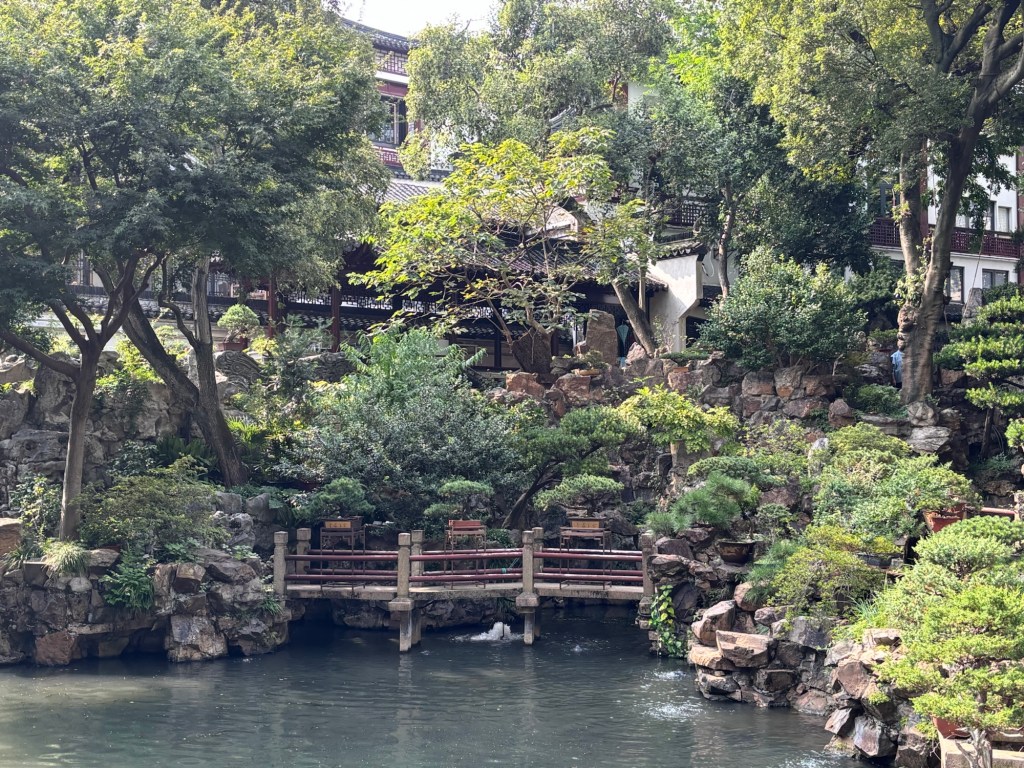
This is perhaps the place where we’ve seen the most foreign people (So many Russians! You wouldn’t believe how many Russians!) in addition to the Chinese, but people were pretty civilized so it wasn’t difficult to imagine how peaceful the garden must have been when it was just one family’s playground.
On the way out, we took a look at the small City God Temple, a small courtyard housing a lot of statues, including one of the protector of the city.
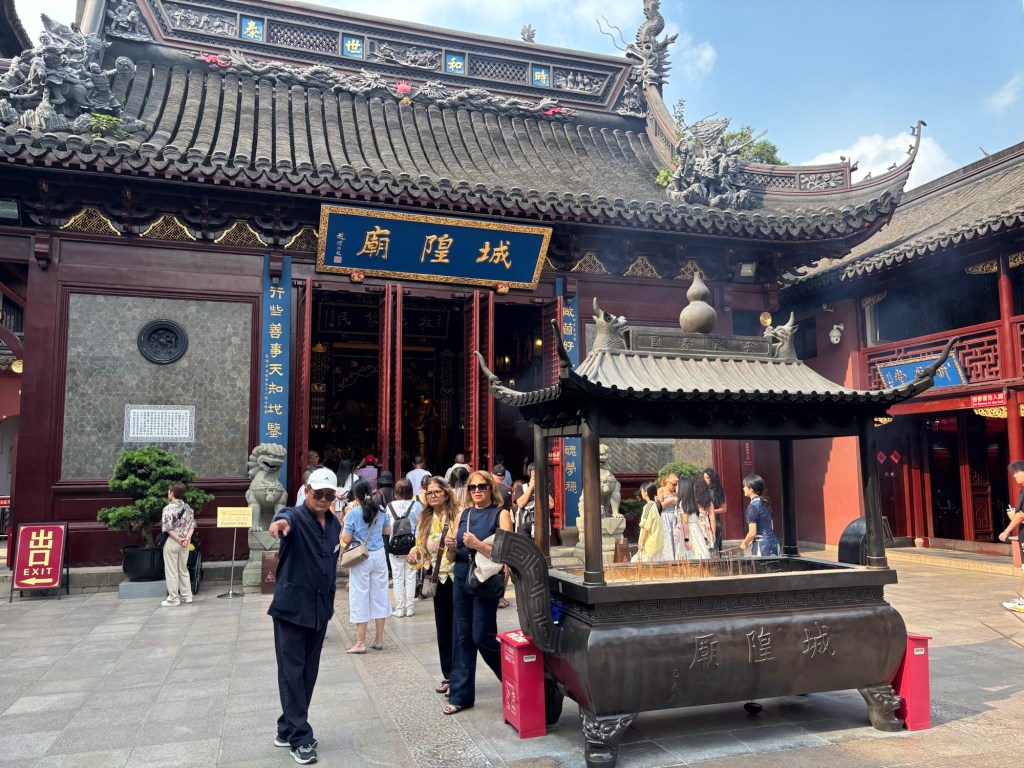
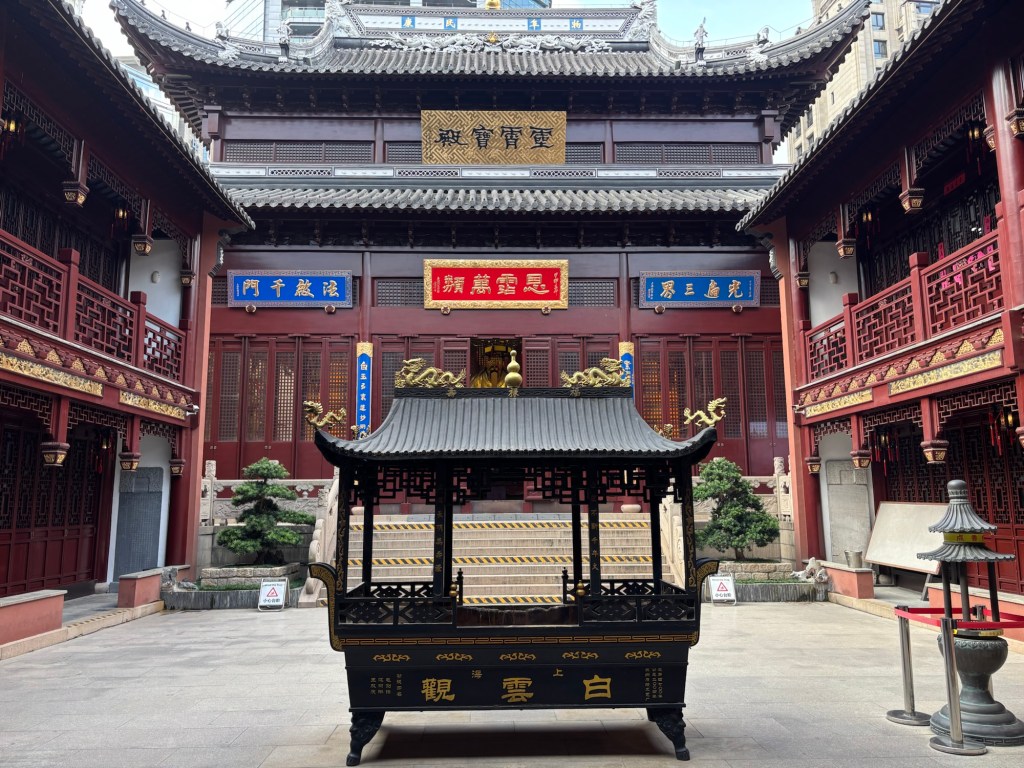
From there, I took off to check out Baiyun Temple, or the White Cloud Temple, because I still hadn’t visited any Taoist temples in China, but was disappointed to find a tiny temple with just a big golden statue of the Jade Emperor as its claim to fame. What a pity Qingyang Temple in Chengdu was closed when I tried to visit! At least on the way there I walked past a beautiful ceramics shop and bought myself a cute ginkgo-themed mug.
From there, I went back to Nanjing Road to check out an anime mall, only to find that the Evangelion store I was looking for didn’t exist anymore and Amap is out of date. I took the opportunity to browse through the Animate and Kotobukiya stores, but didn’t find the merch nearly as interesting (to buy or even to peruse) as their original Tokyo stores. I had such high hopes for this place!
There was one last cultural experience on my plan for today: hot pot! It’s just about the only Chinese food staple that we haven’t had yet (I mean, I’ve had hot pot before, just not the real deal in China), so I chose to start from the top with Haidilao, a hotpot chain that’s famous for its quirky service, like letting guests get a manicure while they wait, doing a kung fu dance when they make noodles, giving out freebies like snacks or ice cream, and generally having good service.
I’d read up online on how the whole thing worked beforehand and even then it was a bit overwhelming, but in essence, you first choose which stocks you want for your hotpot (I went with a two-stock base, mushroom and tomato), then choose the food you’re going to cook (meat and vegetables, for example), then drinks, all from the iPad, which at least was in English. Then you also go to the “sauce bar”, which is an area where you can make your own sauces from a lot of different ingredients they have available like chili flakes, coriander, sesame oil, garlic, etc. A lot of moving parts!
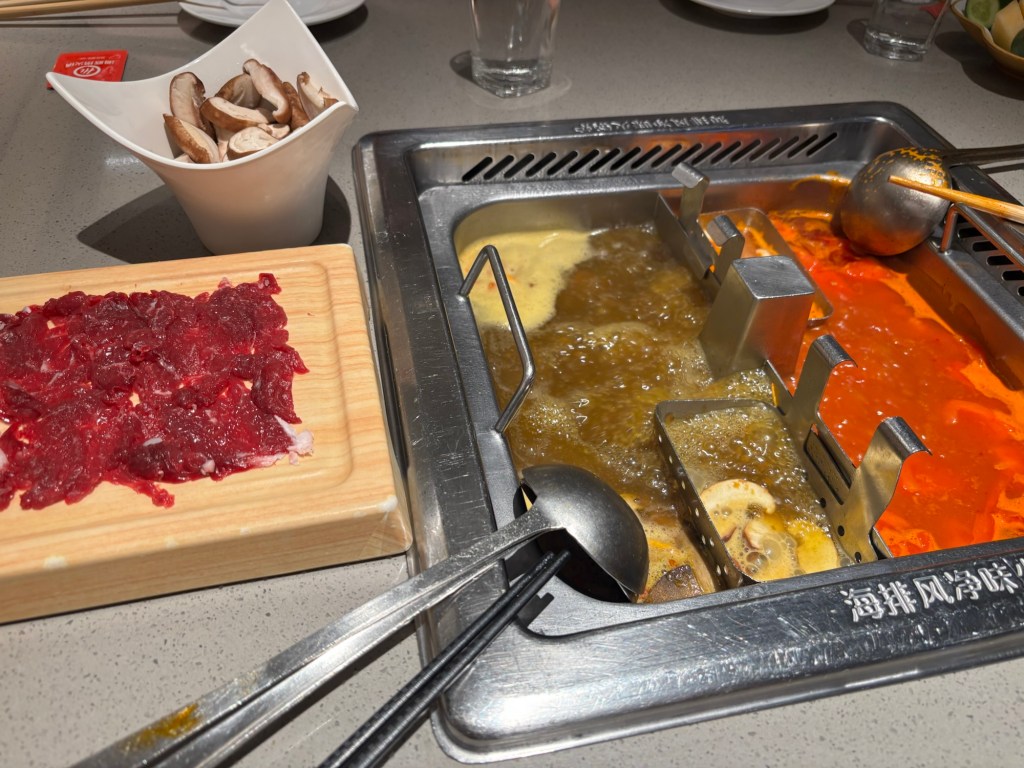
The food was good, although I can definitely tell this is a skill that one needs to practice, if nothing else to understand what we like and how we like to go about it. I was satisfied enough that I didn’t feel like ordering anything else, but not so full that I didn’t happily munch on the salty snacks they gave us in a little goodie bag as we left. Another new cultural experience!


