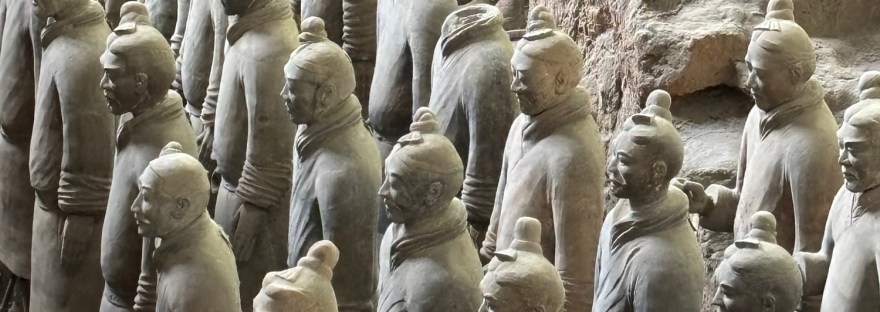
Today’s top priority was the visit to the Terracotta Warriors in the afternoon, so in order to save up some energy for that I made a lightweight plan for the morning: a visit to Daci’en Temple, home to the Big Wild Goose Pagoda (not to be confused with the Small Wild Goose Pagoda, which is located in Jiangfu Temple near the Xian Museum).
I’ll start by admitting that I knew why the pagoda is famous, but I had no idea the temple itself was also so remarkable. The pagoda, a 64 meter tower built in the year 650 CE to house and protect Indian Buddhist relics and scriptures, is obviously significant as a monument and eye-catching as a sightseeing landmark, visible long before you set foot on the temple grounds.
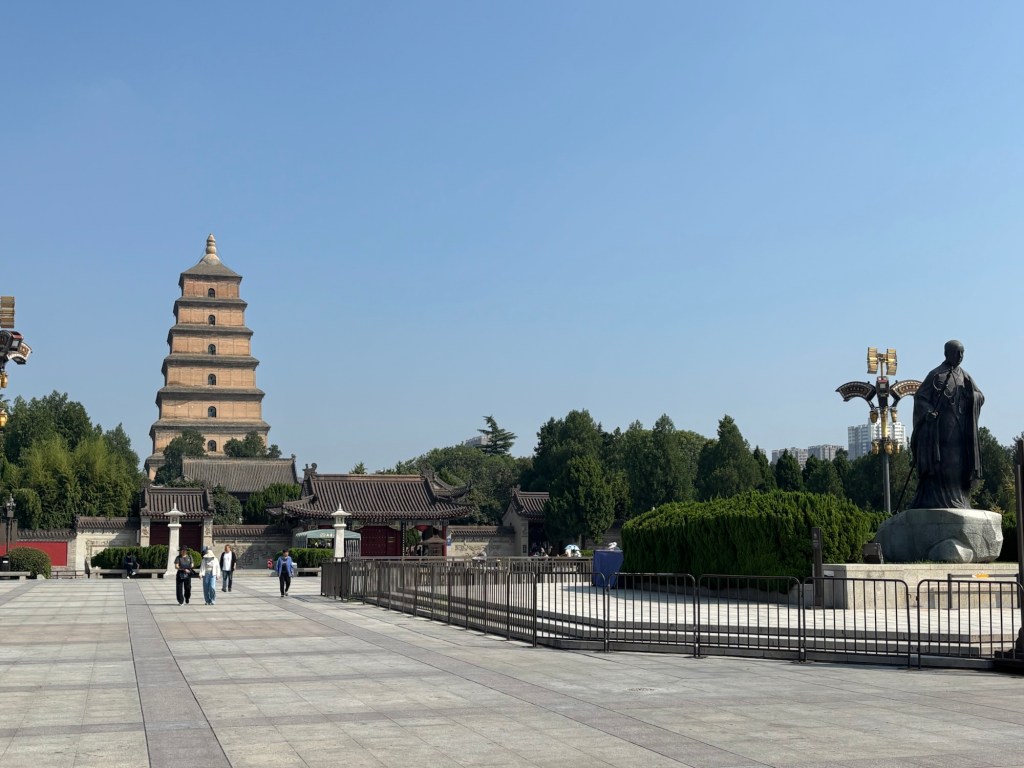
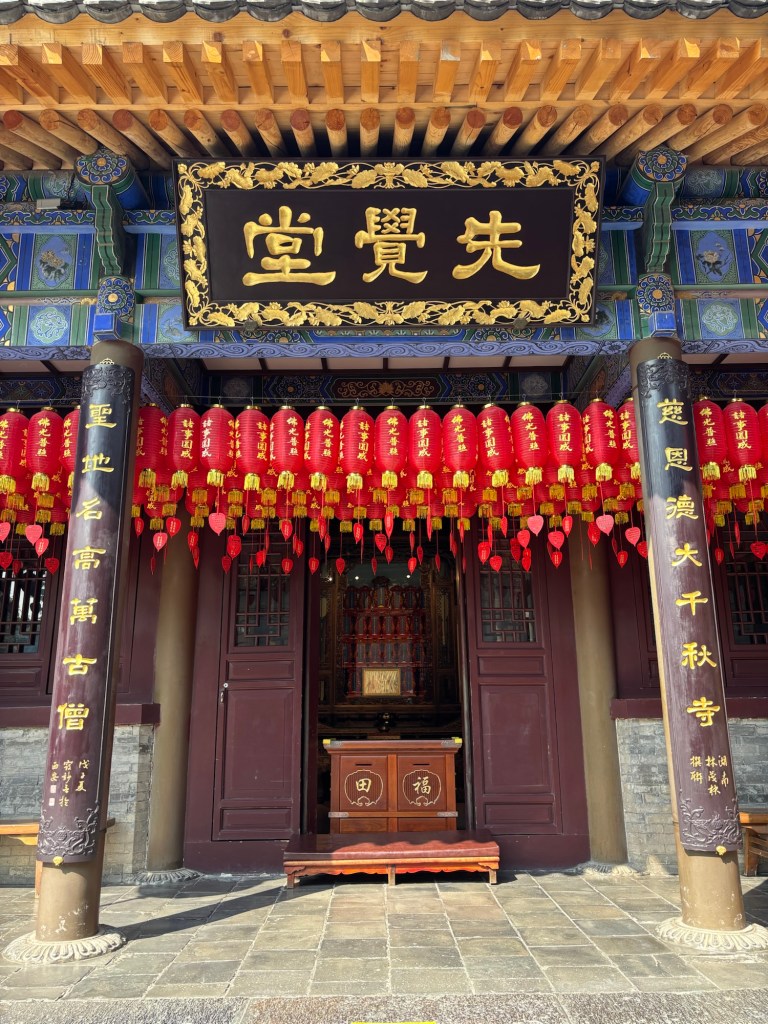
However, after buying a 10 yuan ticket (€1.30) and walking into the beautifully landscaped temple complex, with its spotless pavement and manicured pine trees leaning on their crutches, subsequent signs explained that it was founded by Xuanzang, the Translator Monk, who escaped Xian to train in India and returned to lead this congregation. He was a prolific translator who set down rules on how to translate Buddhist scriptures into Chinese, some of which are reportedly still in use today, including how to apply transliteration (i.e. transcribing a name from one writing system to another).
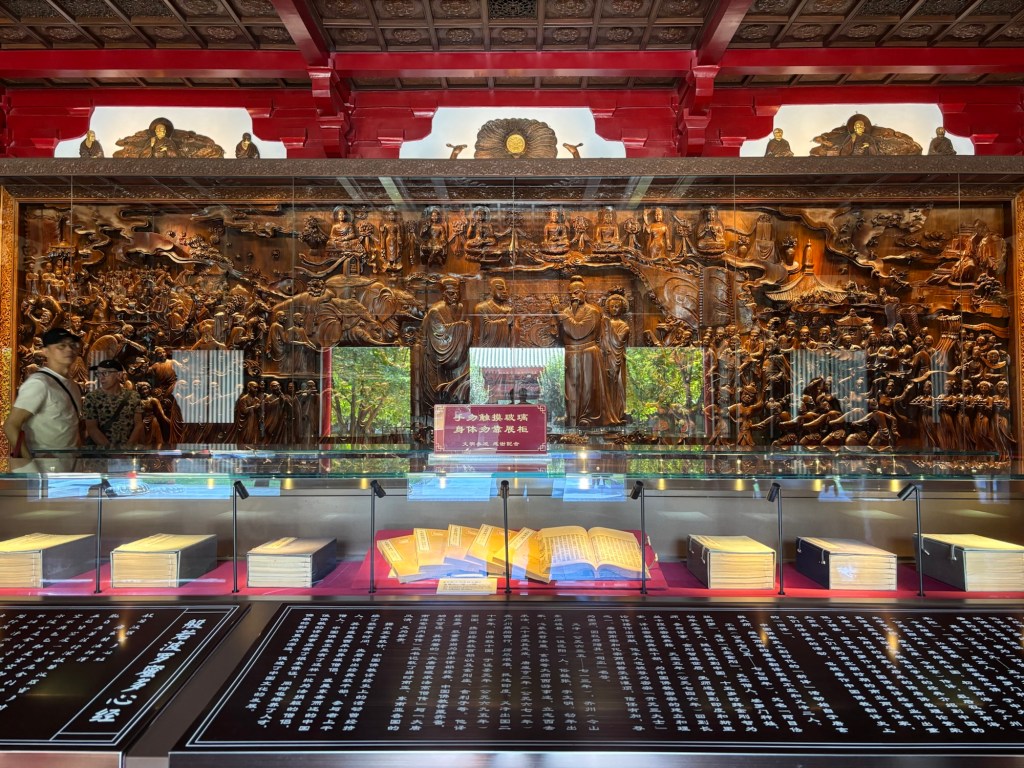
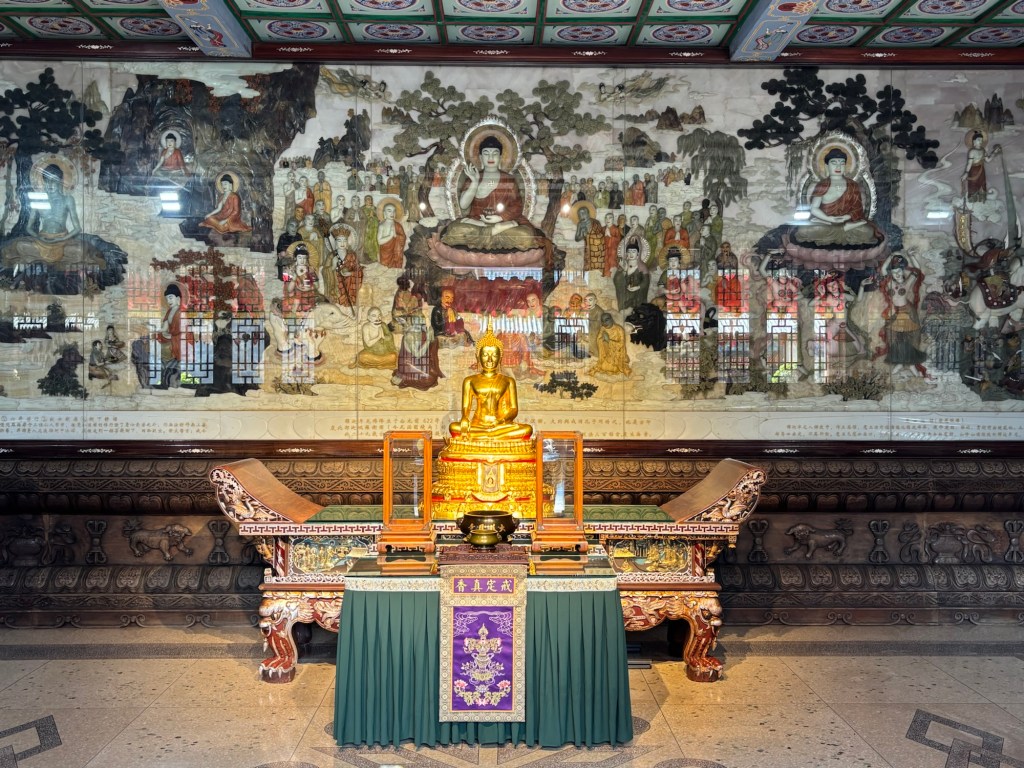
I was even more fascinated to learn that Xuanzang’s magnum opus was a Chinese translation of the Tripitaka, a massive collection of Buddhist sutras and other canons that takes a staggering 321 volumes, stored right there in the temple across 44 cases. I first learned of these texts through the Tripitaka Koreana, Korea’s parallel attempt to the challenge of preserving these sacred texts for posterity. Both are philological achievements of the first order. Here, the tomes are kept in an impressive hall lined with wooden reliefs depicting scenes from the abbot’s life.
As for the temple itself, it’s a delightful visit, both for the pleasant disposition of the various halls and gardens and for the cultural wealth of what’s inside. There are several golden statues of Buddha, some fat like he often looks in China, some with this wispy, elongated look that is typical in ancient Indian sculpture, as well as Guanyin, bodhisattva of compassion, with her many arms (a sign in the garden outside read: “May your hands show compassion and your feet protect the green earth”).
There was also a peony garden with a small but pretty pavilion that was ideal for a rest in the shade!
After finishing the visit, we stopped at a coffee shop for a drink that was really an excuse to sit down and kill time until noon, when we boarded our next Didi to see the Terracotta Army.
Researching this visit was pretty time-consuming, for starters because there is no such place as “the Terracotta Warriors”; you are looking for Emperor Qinshihuang’s Mausoleum Site (note that in Chinese transliteration the Q is pronounced close to our CH, so “qin” is pronounced like “chin”), which is this massive area outside of Xian proper which encompasses all of the dig sites of the Terracotta Warriors but ALSO the actual Mausoleum of Qinshihuang, which makes it super confusing to search for the place in Amap or Didi.
Tickets can be bought online in advance, but you have to select an hour bracket and I didn’t know when we would arrive, so I didn’t book anything and hoped for the best. We made it to the parking lot -welcomed by a large statue of the emperor himself- at one o’clock, then crossed the street to find a truly gigantic landing area that was clearly designed to handle thousands of people at the same time. Now, however, it was pretty much empty, which got my hopes up that maybe my 1PM technique was working again! We went straight to the ticket counter, which was literally empty, and got tickets right away (a Chinese family behind us was breathing down our necks the whole time even though there was literally no one else there).
Our bracket was the last one, 14:30-17:00, which suited us fine as it gave us time to go foraging for lunch. We went to the so-called “Tourist Plaza”, full of knickknack vendors and coffee shops and vendors, but the offerings were really dire: everything seemed to be either very Spartan Chinese fare or American junk food like… well, you can imagine. Thankfully we spotted a Chinese restaurant that looked all right and managed to sit down for lunch. I ordered roujiamo, which is sort of a lamb burger with flatbread; this one was pretty simple but it did the job! Plus it let me finish the trifecta of Xian specialties, as I have now eaten biang biang mian, yang rou pao mo, and roujiamo!
When time had passed and our energies had (somewhat) replenished, we set out to the ticket gate, where I was a bit nervous… but found once again an entirely empty queue! We walked right on to the ticket reader and then on to yet another big square where people can take the bus to the mausoleum (remember that’s an entirely separate part of the park), walk 500 meters to the dig sites, or pay 5 yuan (€0.65) to be driven in a big golf cart. We took the cart -that’s 500 meters saved!
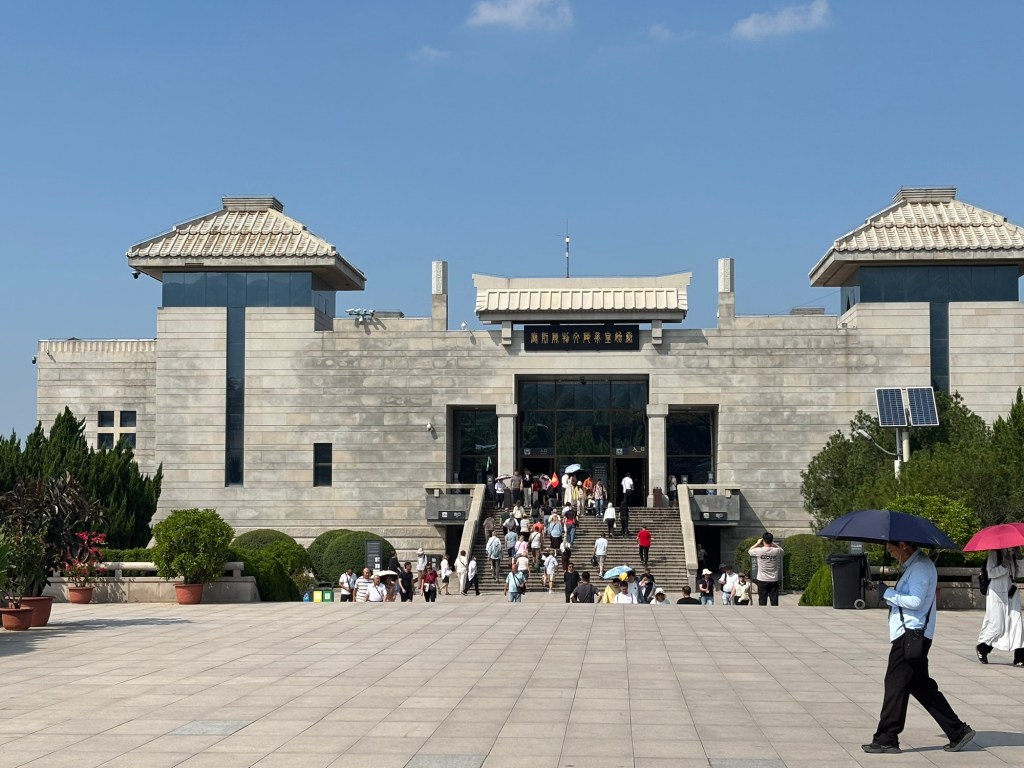
There are three dig sites and we started from the top, with the first one. Here again I was scared of the crowds that we might find inside (after all, there were few people at the entrance but previous groups were still working their way through the exhibits)… but I was shocked and relieved to discover that there were fewer people than even in my wildest fantasies. It was still crowded, mind you, but not nearly as much as usual, so it was easy to get to the front line in any spot I wanted to take pictures as close as humanly possible to the statues.
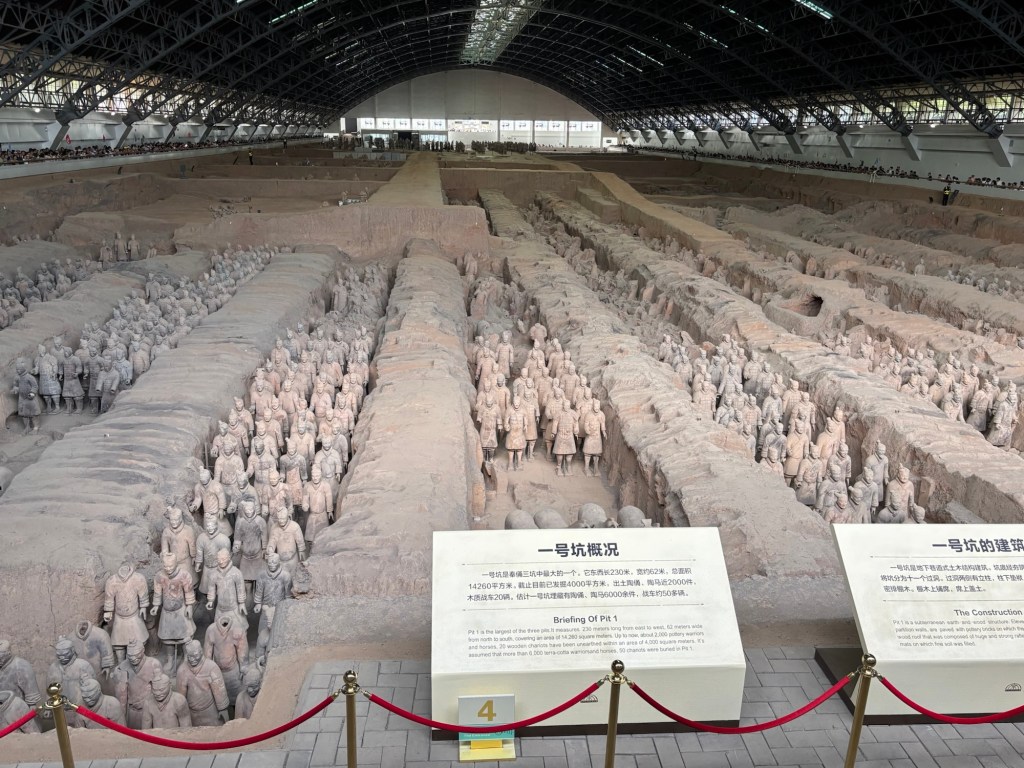
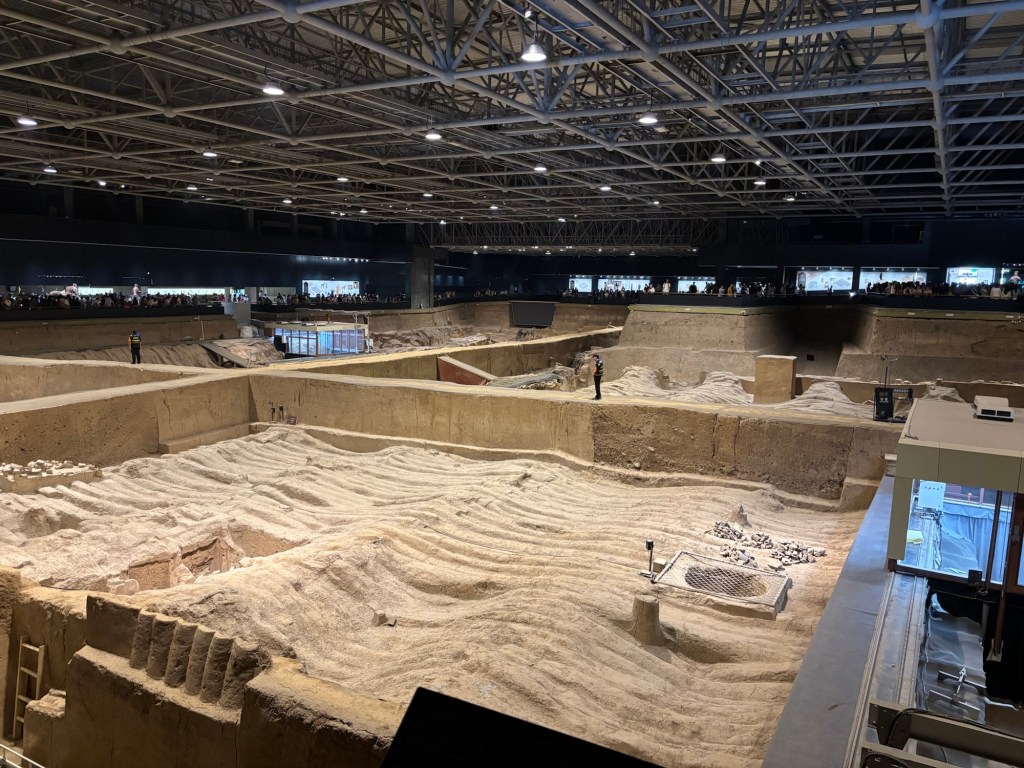
Then, as for the statues… It really is a sight to behold, the whole hangar spread out before oneself, literal thousands of earthen statues staring silently back at me. The pictures definitely do not do the scale of the project justice. For example, even from the platform above it is immediately apparent that every statue is different, because even from far away you can tell their hairstyles or facial hair or clothes differ from one another.
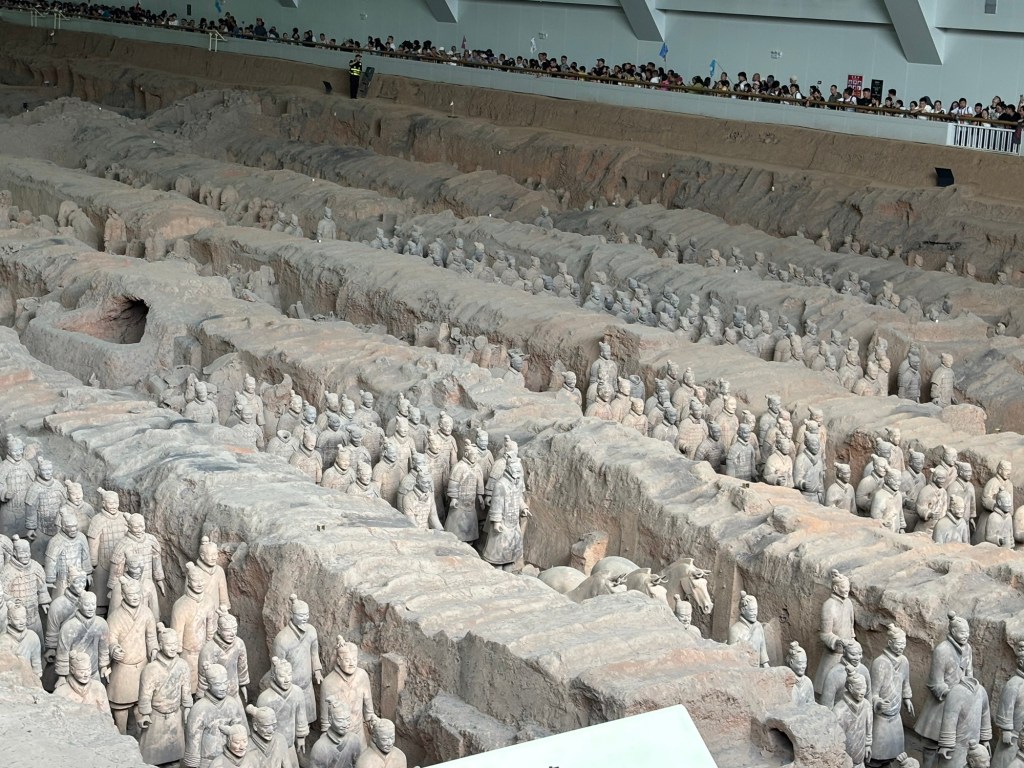
The first site is the biggest and most spectacular, also the simplest as it’s one big square. We walked along one of the lateral walkways all the way to the exit at the end, which leads towards the entrance to Site 3.
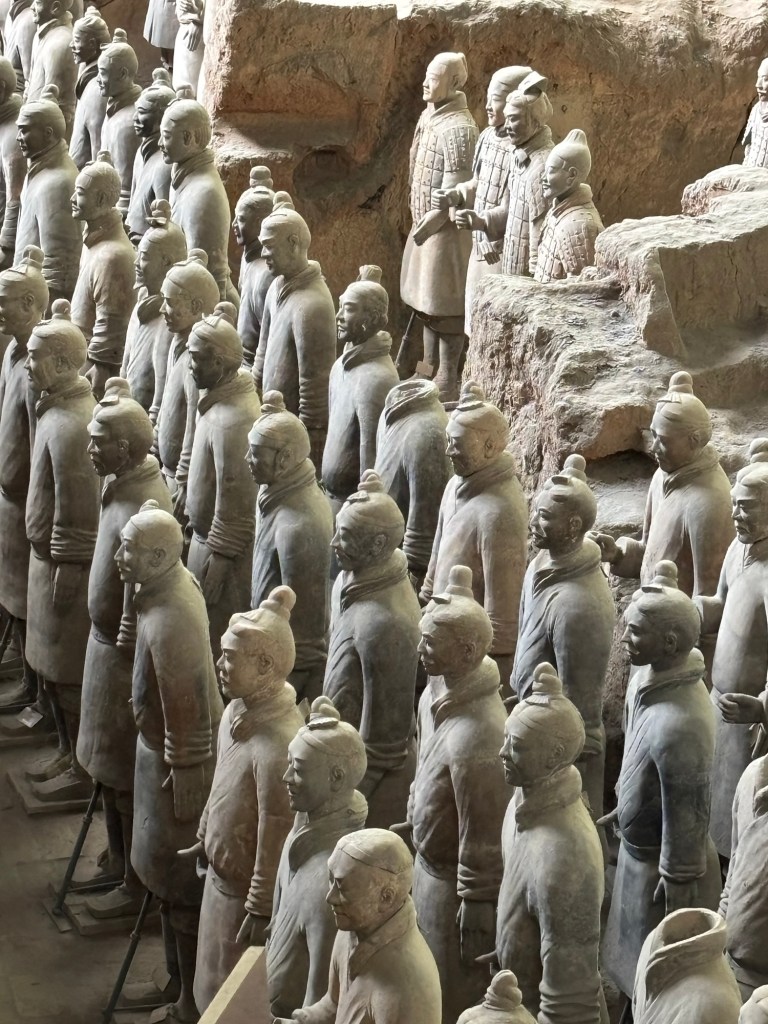
Site 3 is the smallest one, weirdly shaped like a small maze, and the statues in it are almost all broken. It’s a quick visit; I think its historical significance lies in the fact that they found archaeological instruments like carts, hammer, chisels and the like in here.
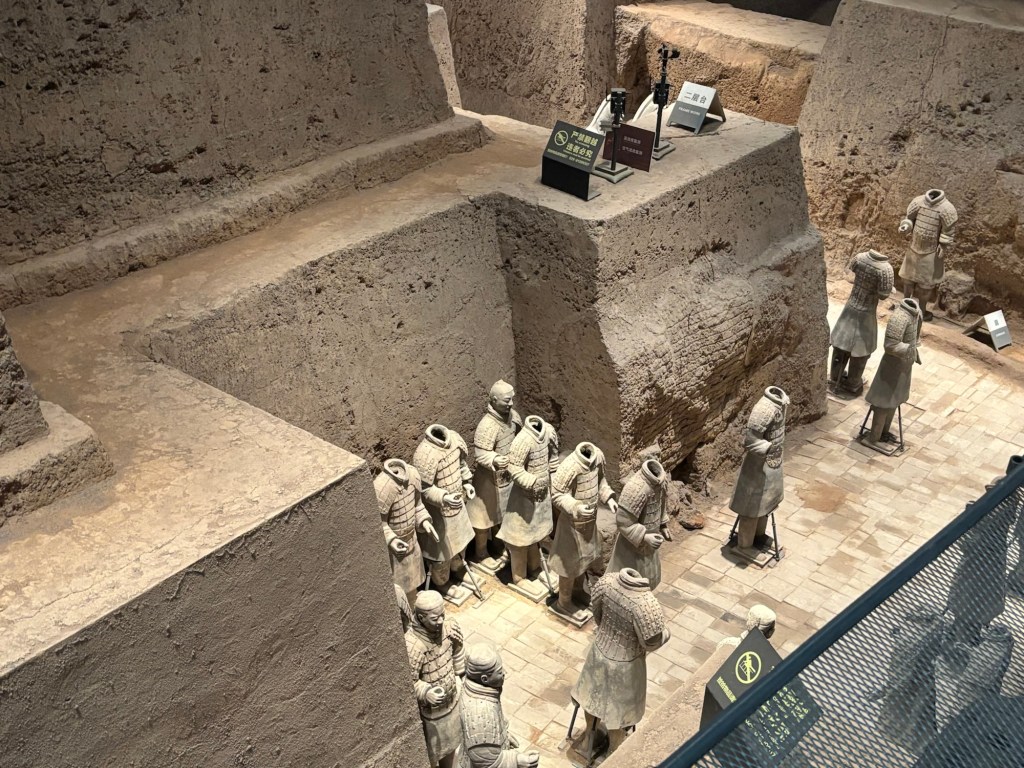
The second site is bigger, but a lot of it is still uncovered; I could actually see staff at work inside a covered workshop right there on the grounds, plus all sorts of weird machinery and rails that must be used to excavate and transport more statues. It’s exciting to know that since its discovery in 1974 it’s still an active dig site!
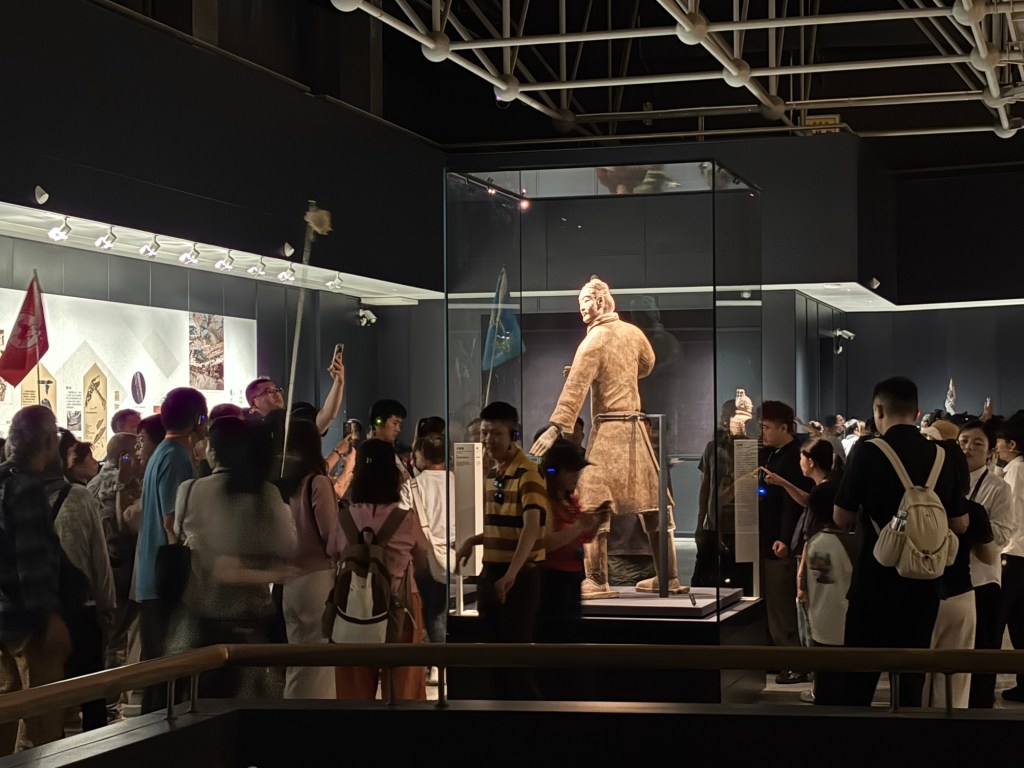
I also really liked the glass clases exhibiting individual statues, the better to observe their different poses, faces, and armors. In this site, they buried not only footmen, but also archers, light and heavy infantry, and even cavalry units, along with their officials in different attire.
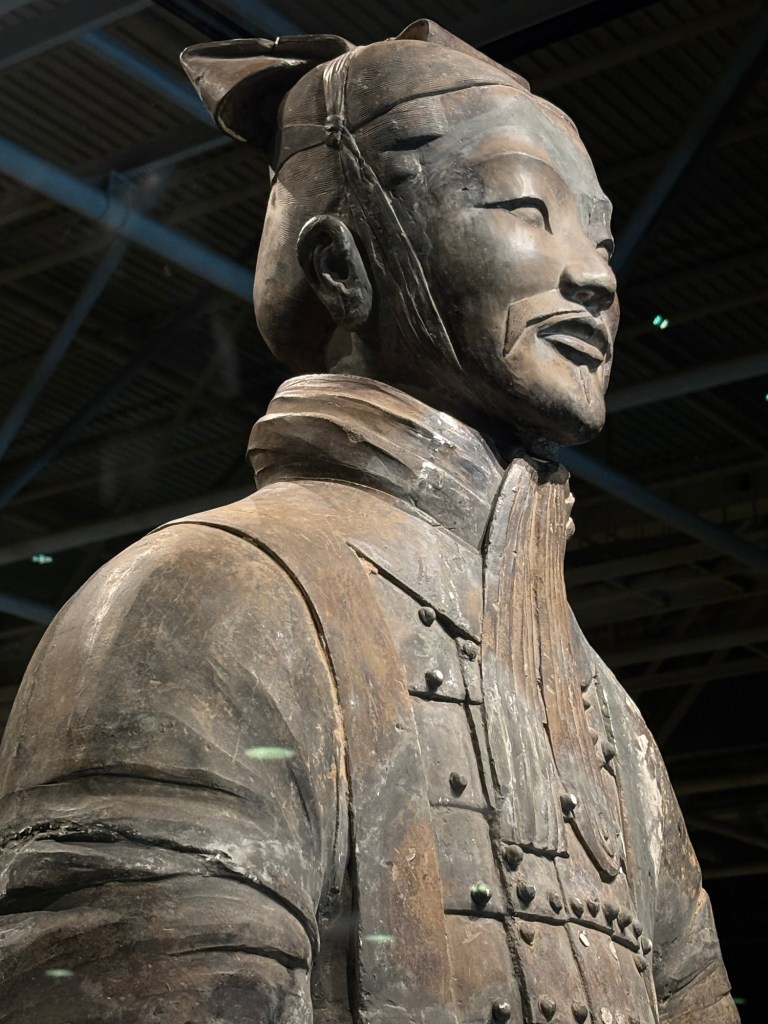
This space was the most crowded of all, also dimly lit, but maybe because I’m used to the Chinese element now it didn’t feel annoying at all, and if I wanted a close up of a statue I just walked up to it and took it like everyone else. If I stepped in front of someone they didn’t mind, and if someone stepped in front of me I didn’t mind. Maybe this is the way to enlightenment!
(The one disappointment: the souvenir shops are all pretty tacky and low grade. I wish they had at least one that had classier figures to take home, I would have been in the market for something to remember this day by.)
By the time we finished all the dig sites it was past four. With the closing time at five, visiting the mausoleum a whole bus ride away seemed as exhausting as it was infeasible, so instead we sat down on a bench in the tourist plaza before heading out. I spotted a bubble tea shop that advertised some form of mango drink so -remembering my trip to Thailand and how I had mango shakes at every opportunity- I jumped at the chance and walked into an empty shop with just two girls behind the counter. I tried to navigate their WeChat menu but it was incomprehensible, so I put my one year of Chinese to practice and asked if they had a mango drink. I then ordered it medium, and cold (I don’t know who orders warm mango boba but I guess someone must), and got to ask the price before inputting it in Alipay. I got my drink and the barista said “Your Chinese is really good!” and gave me two thumbs up. I said “mei you mei you”, which is the equivalent of what I would say in Japanese, although I don’t know if in China you’re also supposed to deflect compliments -but anyway I said that I am Spanish and that I am learning Chinese, much to the two girl’s celebration. I’m still riding this high!
The drink, as far as I could tell, was a mango milk bubble tea, and it appeared to have tapioca balls as well as actual bits of mango and pomelo. It was pretty good, I’m not normally a boba enjoyer but this one wasn’t overly sweet.
After that, there was only a Didi ride back to the hotel left to cap off the day, and with it our stay in Xian. Even though it’s been just two days, I really feel like I got to explore the city, its culture, Shaanxi cuisine, and experience the unique world heritage site that is the Terracotta Army. As far as traveling goes, I could hardly ask for more.
One last update: we ventured out of our hotel and into the Furong New World mall to find someplace to eat. I chose a Japanese restaurant because A) I already ate all the Xian food I set out to eat and then some, and B) I hoped there might be Japanese speakers there so I could communicate better than with Chinese.
They absolutely did not speak any Japanese, but the lady who waited on us was seemingly charmed by my attempts at Chinese because she brought out some kind of non-sparkling champagne for us to toast with, and she also complimented my Chinese so I am bursting with pride! I had pretty good tonkotsu ramen, and a braised fish covered in peppers that looked very similar to what we might see in Chengdu. A great farewell to Xian!


