Day One of Two in Xian and I am SPENT. By the end of this trip they’ll have to roll me onto the plane with a wheelbarrow!
Today’s plan was to visit the old town of Xian, that is, the square area within the old city walls, and leave the famous Terracotta Army for tomorrow. We were cheered on by a gloriously cloudy, cool day, perfect for sightseeing. If I’d had this weather at the Great Wall I would have made it to Tower 23!
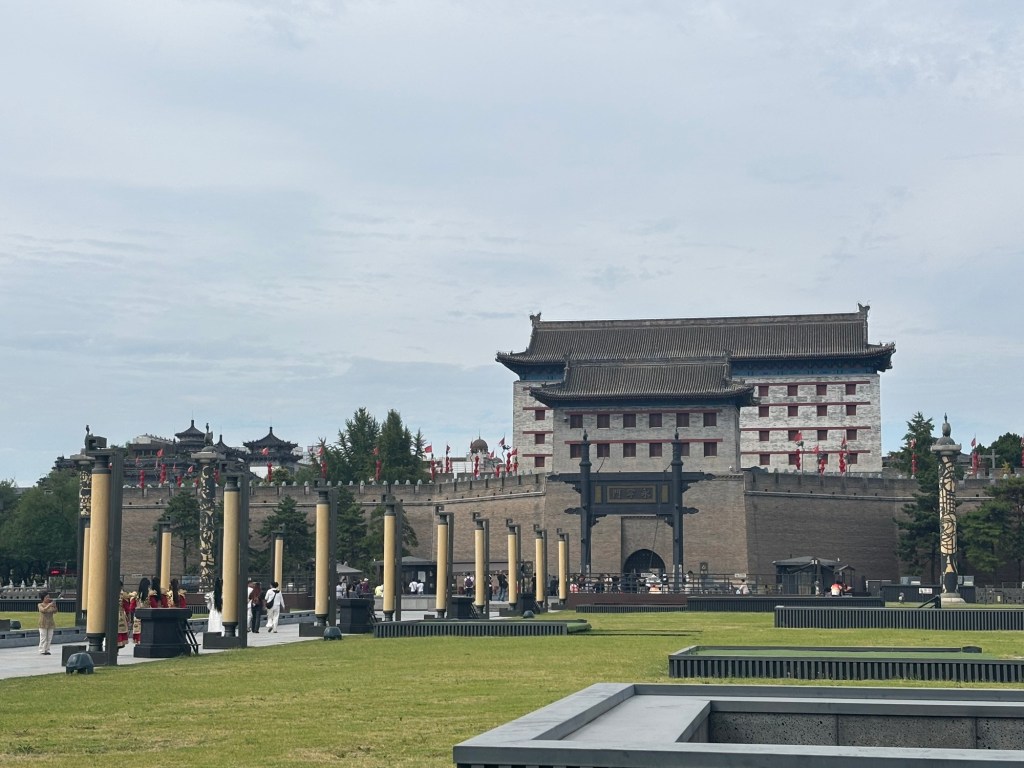
The first step was to take a Didi from our hotel to Yongningmen, the South Gate (the downside of getting a huge swanky hotel is it’s a bit far from the main sights, but I’d say it’s well worth the ride), and from there take a short walk west towards the Forest of Stelae Museum, along a lively commercial street that was clearly still waking up; my working theory is that in the morning all the tourists are at the Terracotta Army dig site, and alight onto Xian city proper in the afternoon, so this part of town was just for ourselves and only a handful of Chinese tourists.
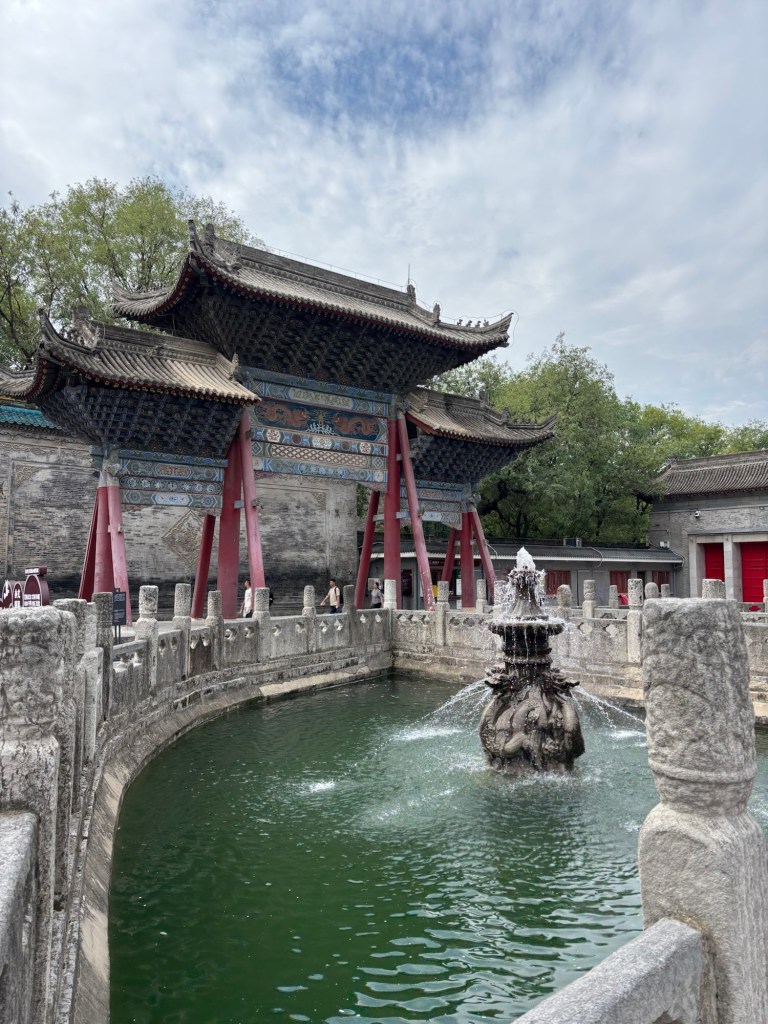
From the guidebook, I’d gotten the idea that the Forest of Stelae was “just” a temple, like the Temple of Literature in Hanoi, with a collection of engraved stone tablets inside. As soon as we paid the relatively expensive tickets and saw the map, however, I realized I couldn’t have been more wrong: the temple part is merely the entrance to a massive complex that took us through a garden with six pavilions, a grid of small buildings with different collections, and finally, a giant museum with three extensive floors divided into two halves each.
The grid-like buildings at the beginning house massive slabs of stone with all sorts of written inscriptions. I was particularly impressed by a set of stones that constituted the oldest existing dictionary of Chinese, dating back to the year 200 BCE no less. How impressive is that?
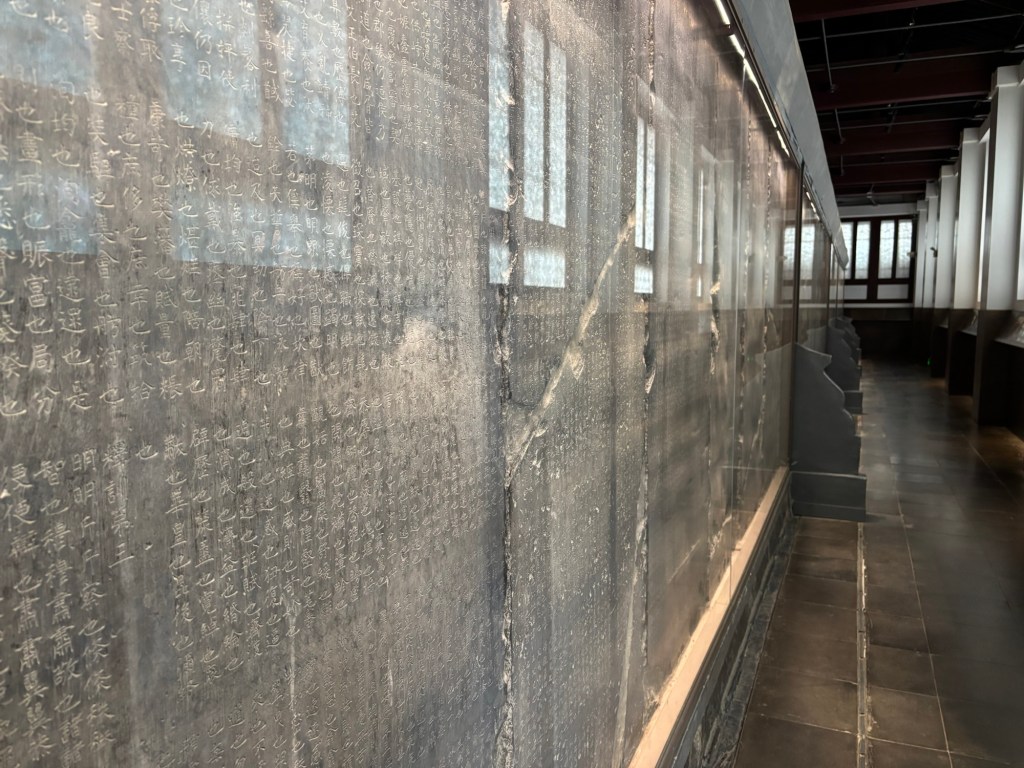
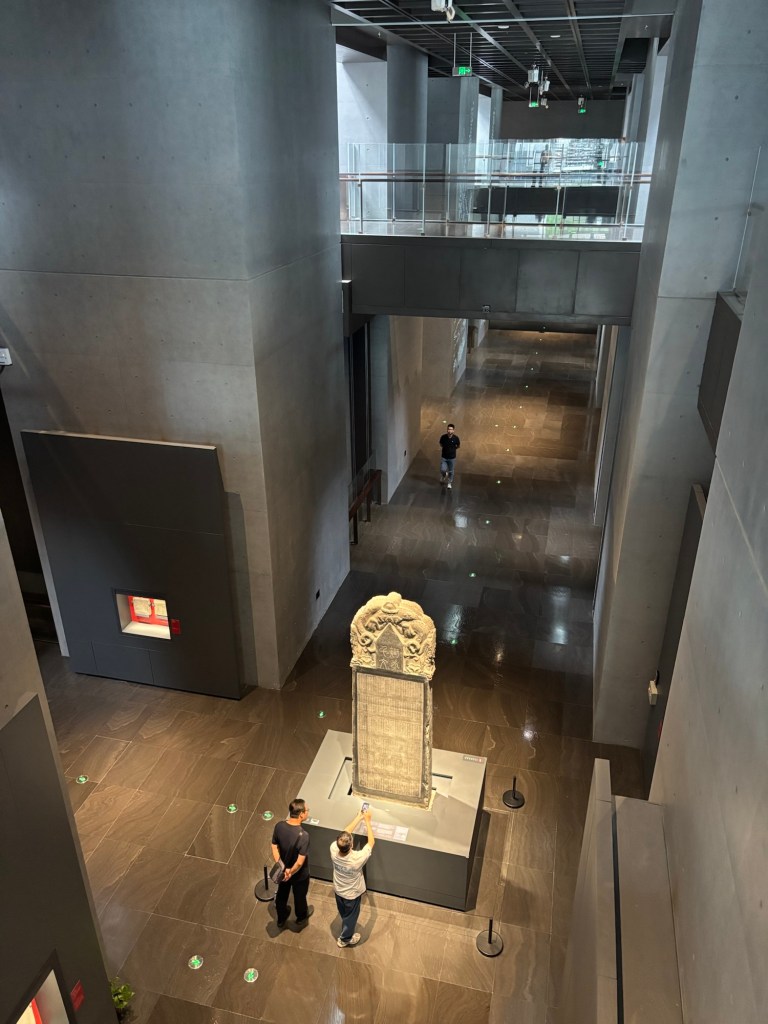
Then, the inside of the museum is a very contemporary, sober space all decorated in dark gray colors that compliment the soft grays and sand colors of the stone tablets on display. It’s truly an enormous space; we spent what felt like a long time exploring just the first floor, then gave only a cursory look at the lower level, and did not even attempt the third basement. It is perhaps obvious that one can only get so much out of this visit without knowing the Chinese language and/or history, but as a philologist I really enjoyed getting to see such ancient examples of writing. It’s incredible that engravings from a literal two thousand years ago look exactly like modern Chinese printing fonts (although I guess you could say the same of ancient Roman inscriptions). I looked at medieval historical records of Confucian doctrines and was able to read the simplest characters!
After this visit took much longer than I expected, we exited through the north and walked through a normal mixed-use street until we came face to face with Xian’s own Bell Tower, within spitting distance of its corresponding Drum Tower, with its own souvenir market underneath.
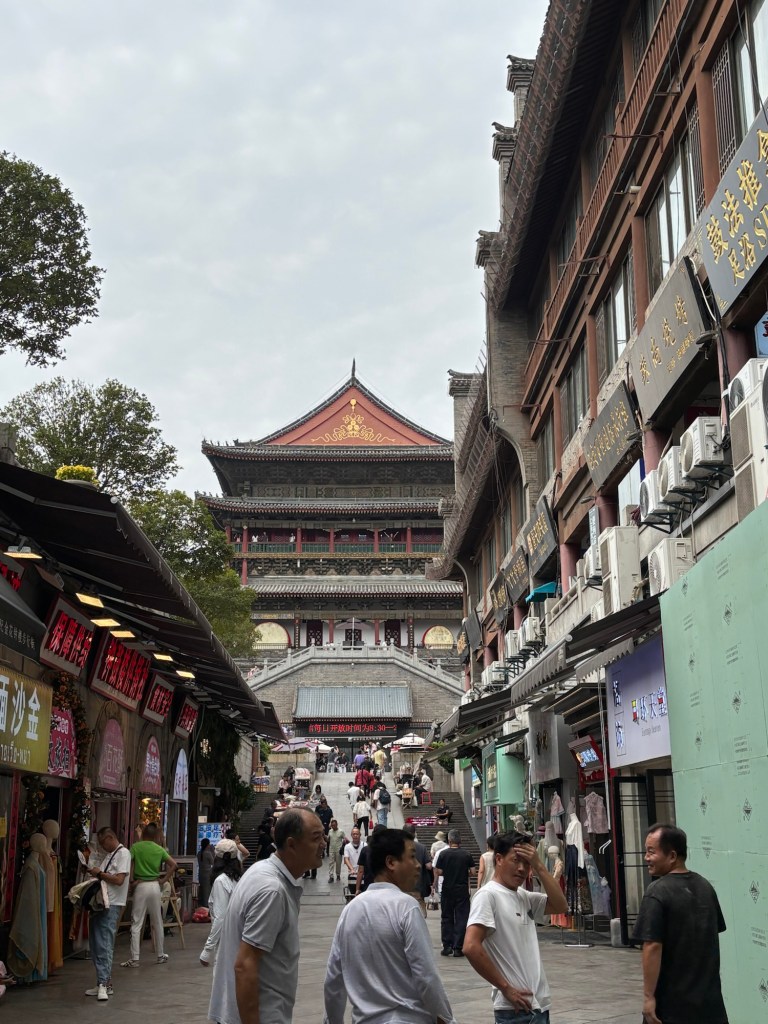
Both towers can be visited, but I think the views from up there are probably not worth the hassle so we moved on until we found ourselves in Beiyuanmen, the main tourist avenue in Xian’s Muslim Quarter.
(Some background: Xian was China’s capital long before Beijing, used to be called Changan -a name that is omnipresent in the city still- and was also one end of the Silk Road, which meant that it was influenced by countless travelers and their cultures for centuries. The traces of this heritage can now be found in the cuisine, in the Muslim Hui people, and in the architecture of modern Xian.)
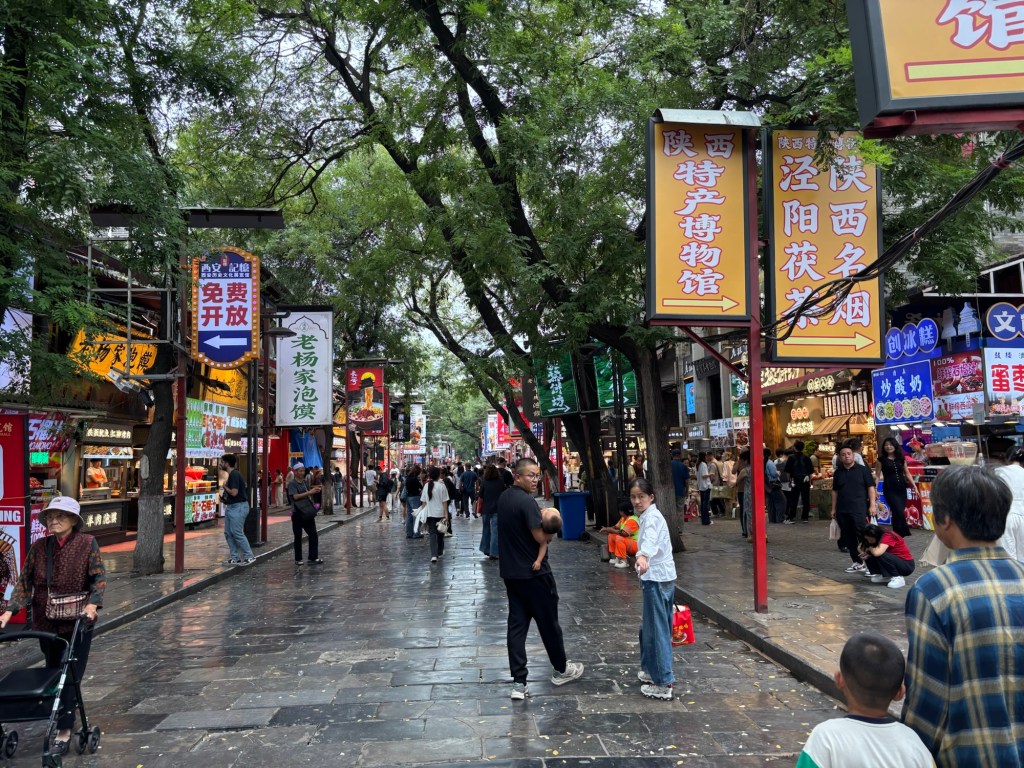
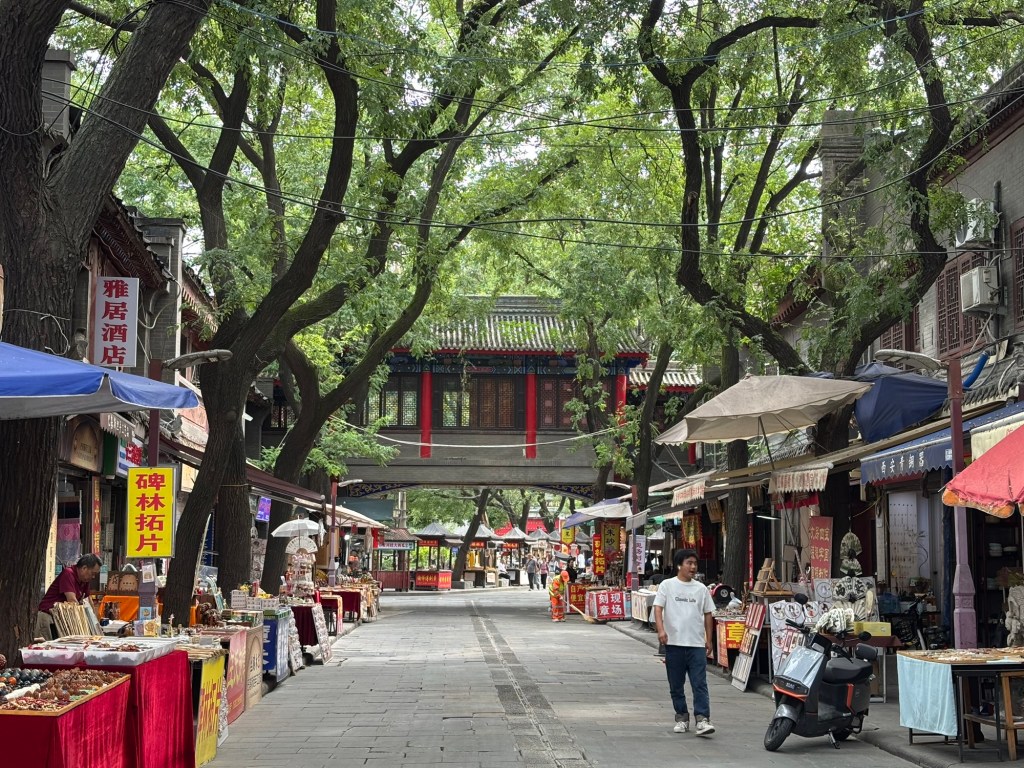
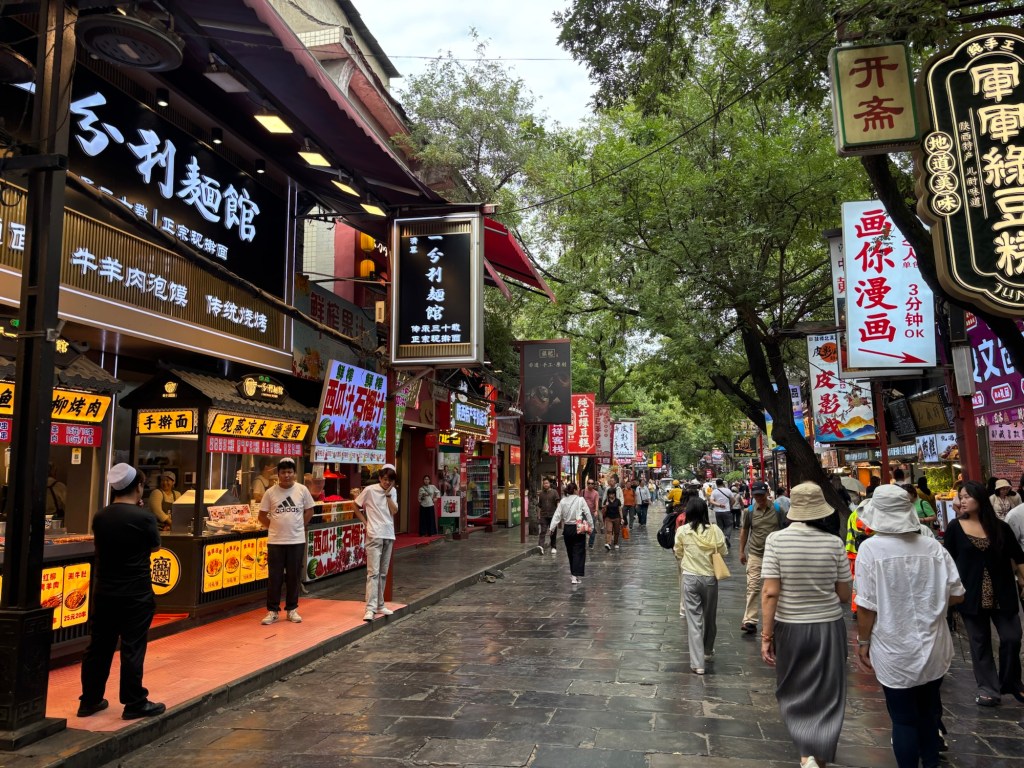
When people use the expression “an assault on the senses”, Beiyuanmen is what they’re thinking of. A straight avenue where the sides are all occupied by street food vendors and souvenir shops blasting announcements or bright signs at the passersby, the smells of all the different foods mixed together… it’s really fun, because of all the variety and the spectacle everywhere you look, but it does get a bit overwhelming if you spend a long time there.
Unfortunately, we did spend a long time there, because I wanted to go to the Great Mosque which was right there on the map but for the life of me I couldn’t find the accesses that appeared on the map. We ended up having to go almost all the way around until there was finally an opening.
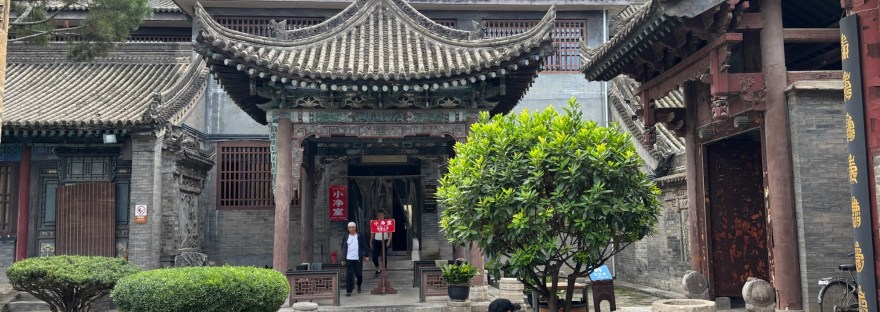
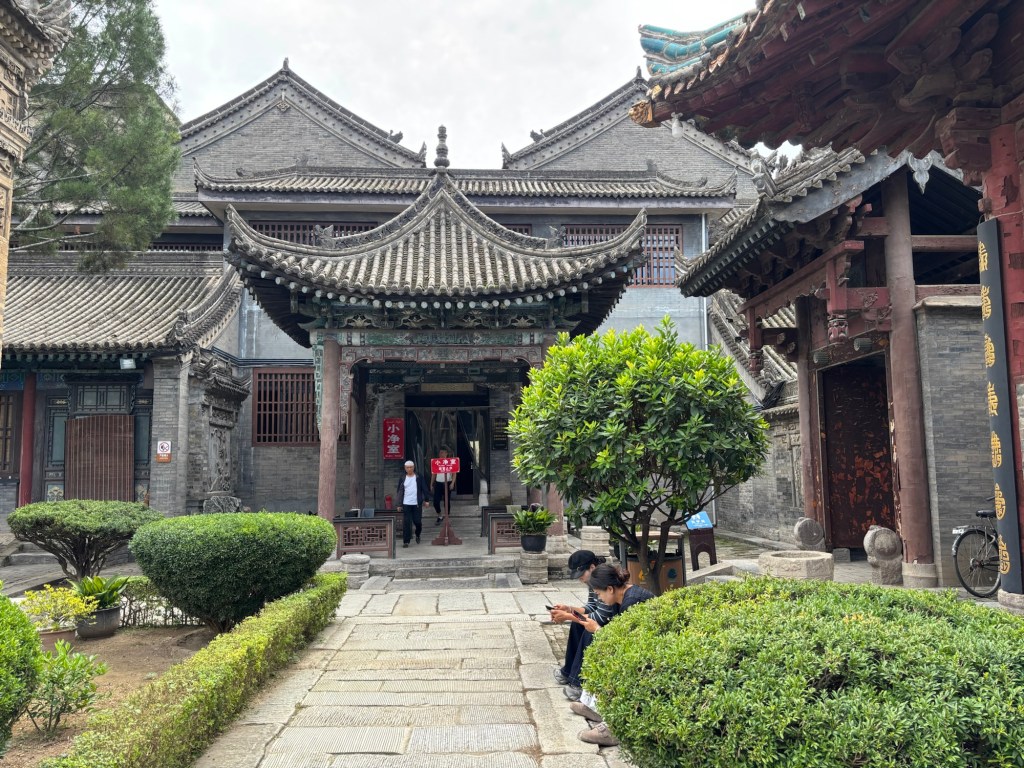
After buying the requisite ticket, we found ourselves in an oasis of peace, a tranquil garden that looked just like any other Chinese temple -if not for the occasional Arabic writing on the walls. There was really no trace of the hustle and bustle of all the vendors and crowds just one street over, as if they had never existed.
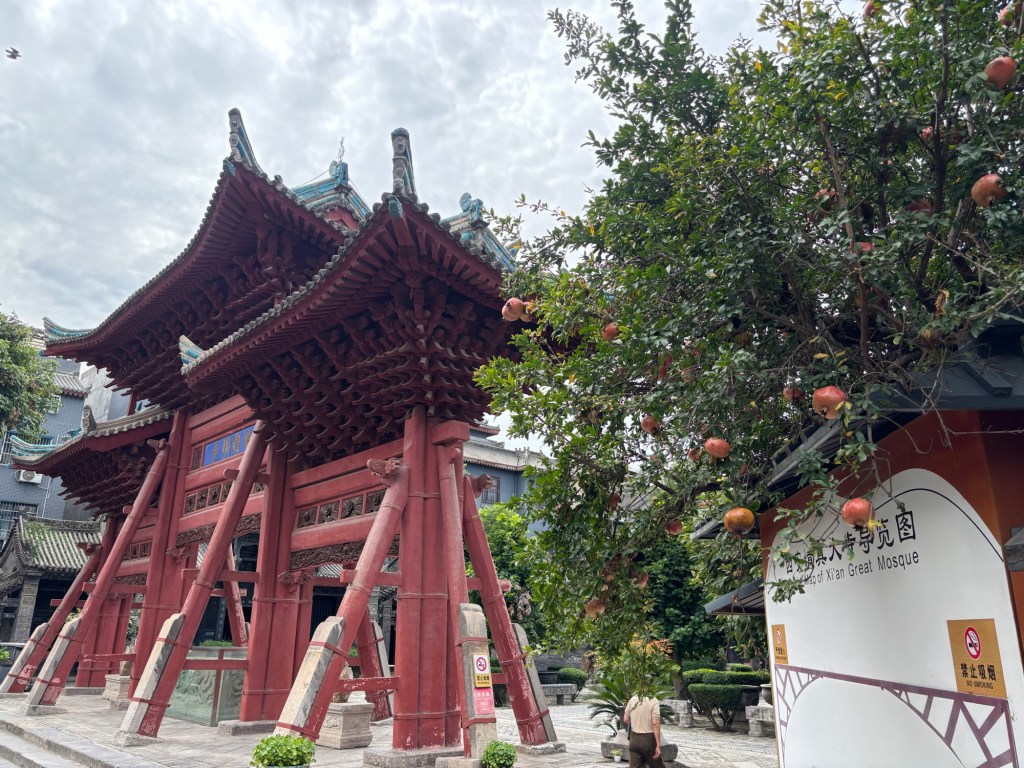
As it happens, we came in just as they were calling out for the one o’clock prayer, so we saw men in robes walk into the prayer hall, leaving the grounds deserted while we did our visit. We could see them praying when we got to the very end.
When we walked out, at about half past one, I had to form a plan out of a number of separate, potentially incompatible facts:
It was lunchtime.
I was determined to have biang biang mian for lunch.
I had scouted some places that specialize in biang bian mian.
These places were all really far away.
I was exhausted.
How to square them all together? Would I give up my vow of eating the Xian specialty? Or get on a cab and arrive at a restaurant who knows when?
In the end, I managed to thread the needle by going to a nearby Hui regional restaurant recommended by my guidebook, which among many other things also had my precious noodles. Success!
Seated at the restaurant, I was struck by the cultural differences in European and Chinese social interactions. Our waitress was no-nonsense, strictly business, and was strongly rushing us along to place our order, which in Europe we would read as pushy or rude, but she was not unkind: because we spoke in my year-one Chinese she repeated every order back at me, showing me the pictures on the menu to make sure we knew what we ordered, and made sure to ask how spicy I wanted my noodles (“Not too spicy!” I managed to say, which made her chuckle; in truth I love spicy food, but I’m scared that a “regular spicy” Chinese dish might send me to the hospital).
So, I got my noodles, and they were only a bit spicy, just like I ordered. They were worth the trouble: wide like a three lane highway, with lots of mutton and vegetables and chili oil to mix, super flavorful.
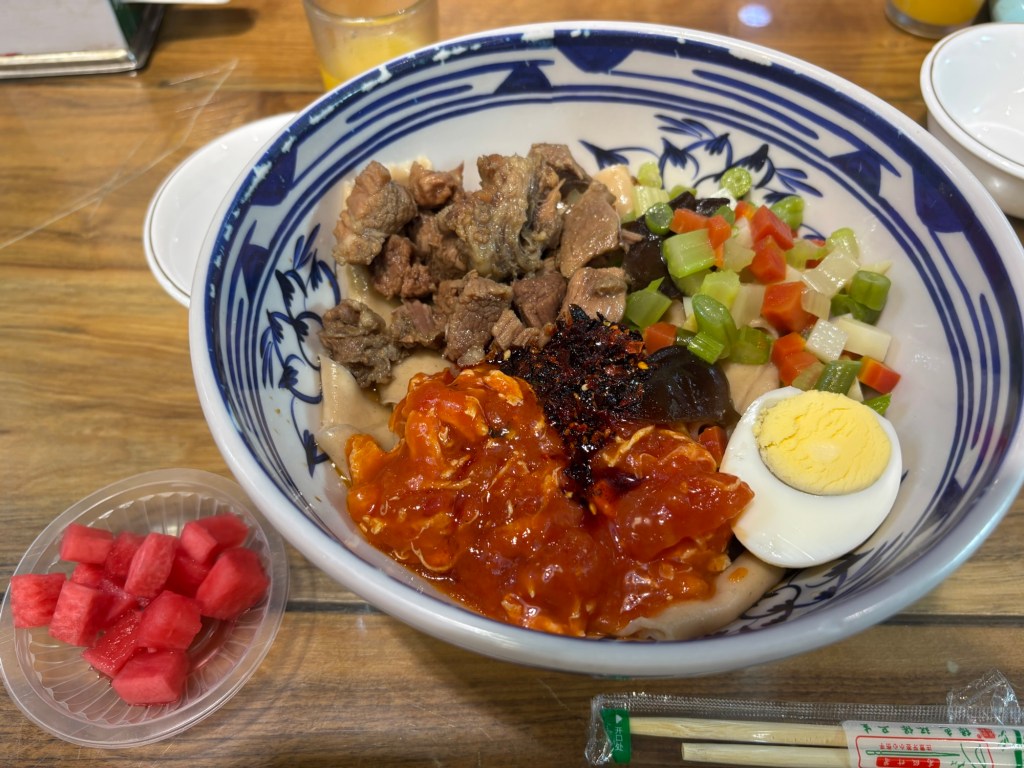
(You might see on the picture that they included a little plate of what I thought was watermelon, so I saved them for the end of the meal. When I munched on one I realized it was radish.)
For the afternoon, I had two alternatives. The first was Guangren Temple, a Tibetan temple that looks beautiful in pictures, but it was on the northwest corner of the city and would have taken us forever to get there and back -plus we’d already seen the Lama Temple in Beijing. So instead we took the metro back to Yongningmen, this time to go up the city walls.
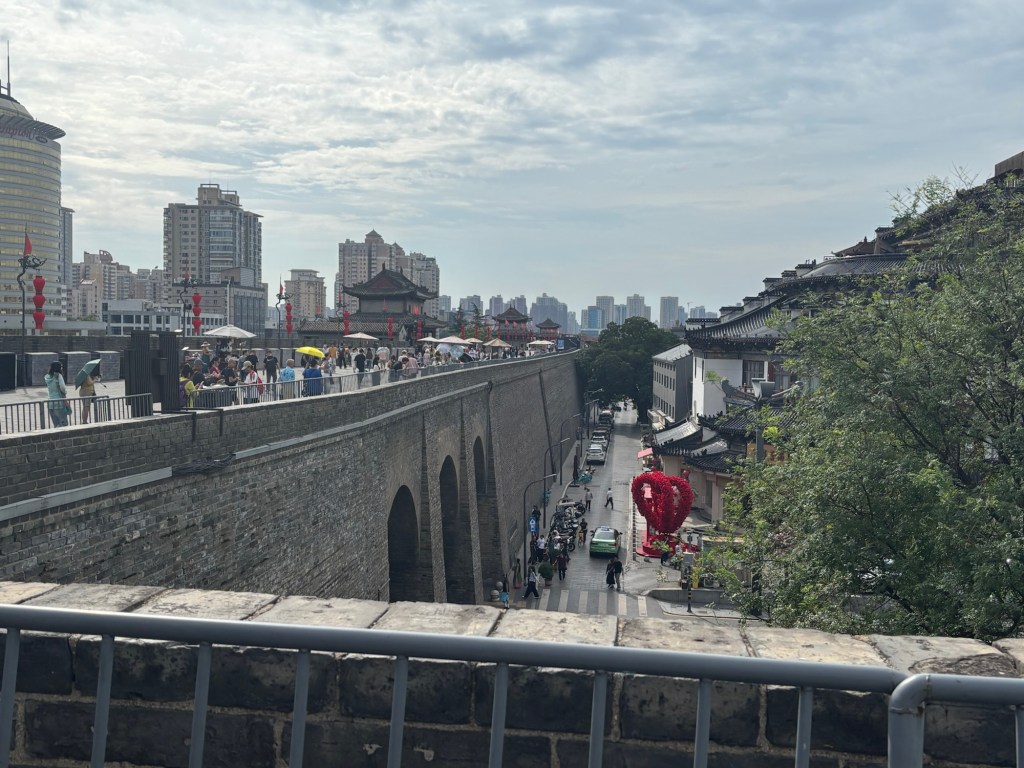
I did not expect to have to pay a ticket, but there you go. The reward is getting a unique vantage point from which to look down at the bustling city below while you take a nice, even walk. To make the most of it, you really should do it early on in your day or rent a bike to cycle along the ramparts, but as it were our energy was running low -had been running low all day- so we just walked the section between Yongningmen and Hanguangmen before descending and calling a Didi back to our hotel for a thoroughly well deserved rest.
Tomorrow we try our luck with the Terracotta Army!


