Oh, the joy of getting up in my own time, having a leisurely breakfast, and being in charge of my day! Today is my last day in Egypt, and also the only free day I get to be in Cairo. My goal for today was simple: to see the two Egyptian museums, the old one and the new. I also noted down some sights in historic Cairo instead case I ended up with extra time but I knew realistically I might not have time for everything.
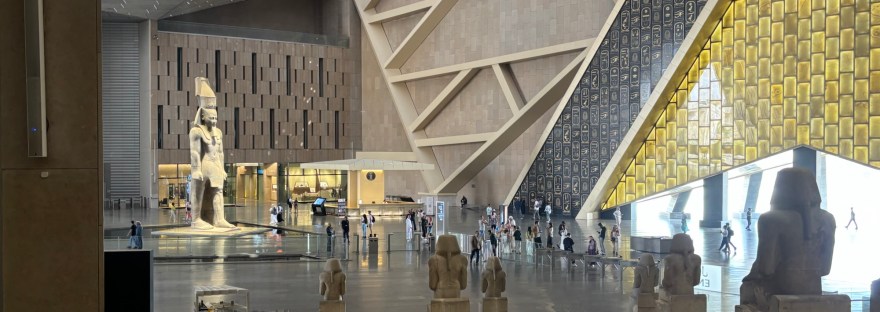
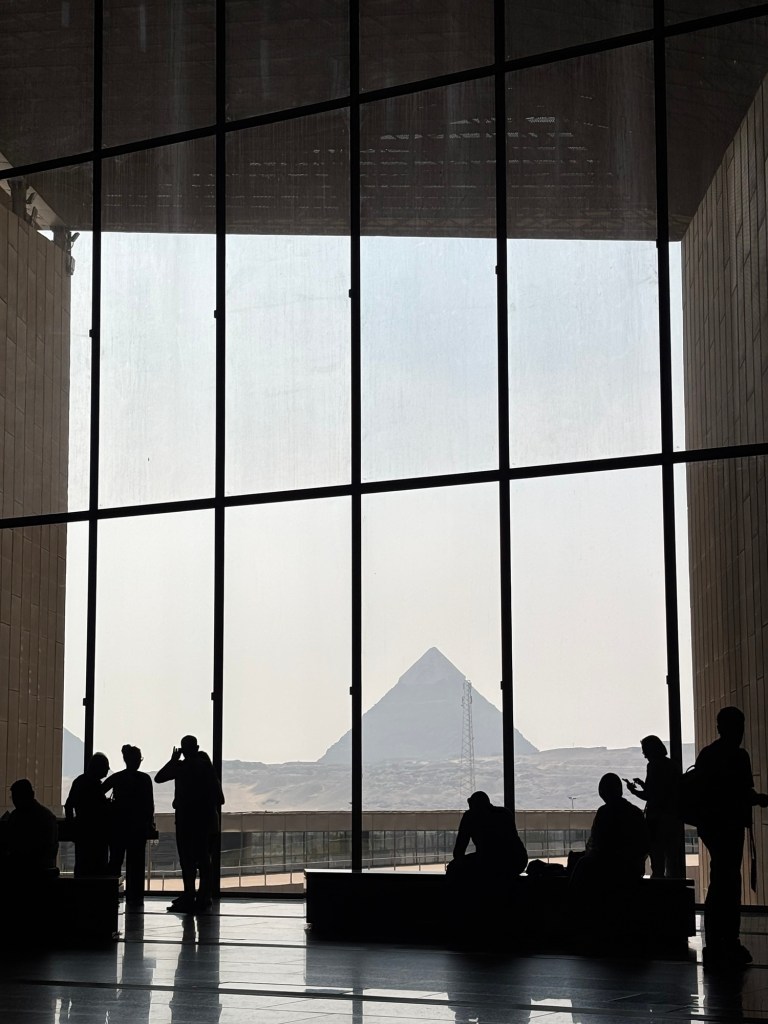
I decided to start with the Grand Egyptian Museum, the brand new archaeological museum constructed a stone’s throw away from the Pyramids. It is so brand new, in fact, that it isn’t even officially open: after having been delayed for years, the GEM will be inaugurated in November, although it is open to visitors for a limited time. Nobody else in my tour group wanted to go because the Tutankhamun galleries aren’t open yet (they still need to transfer the exhibits from the old museum) but I was super excited to go partly because we’re in this curious timeframe where we’re lucky enough to have arrived after it opened but before it closes again in a couple of weeks to prepare for the inauguration. I will get to say “I went to that museum before it even opened!”.
It is clear that the Egyptian government has great ambitions placed in the GEM: it looks like no expense has been spared in its striking pyramidal design, its huge space, the high-end dining and shopping areas, or even the accessibility features that are missing from other local museums. In addition to being a cultural draw for tourists and a symbol of refinement and world-class architecture, I am sure the GEM will be a heavy argument in any Egyptian bid to reclaim stolen artifacts currently held by other museums. The British Museum always uses the excuse that its looted treasures are better preserved there than in their respective countries and that’s why they won’t give them back, but the new state-of-the-art facilities in Greece and Egypt rob that argument of its strength. (Fun fact: there is a law that prohibits the British Museum from selling or giving away any of its properties. But the position of those in favor of the return of looted artifacts is that the museum does not legally own what it illegally acquired.)
It took me half an hour by Uber through the congested Cairo highways to get to the GEM. It’s a bit of a hassle because the museum is so new that the app doesn’t have its location well set: my driver went like “Here you go!” and wanted to drop me in what looked like the middle of a wall on the side of the highway, and we couldn’t communicate so it looked like a bit of a pickle, but then when he started driving again it turned out that the entrance to the parking was like 10 meters ahead, completely out of view.
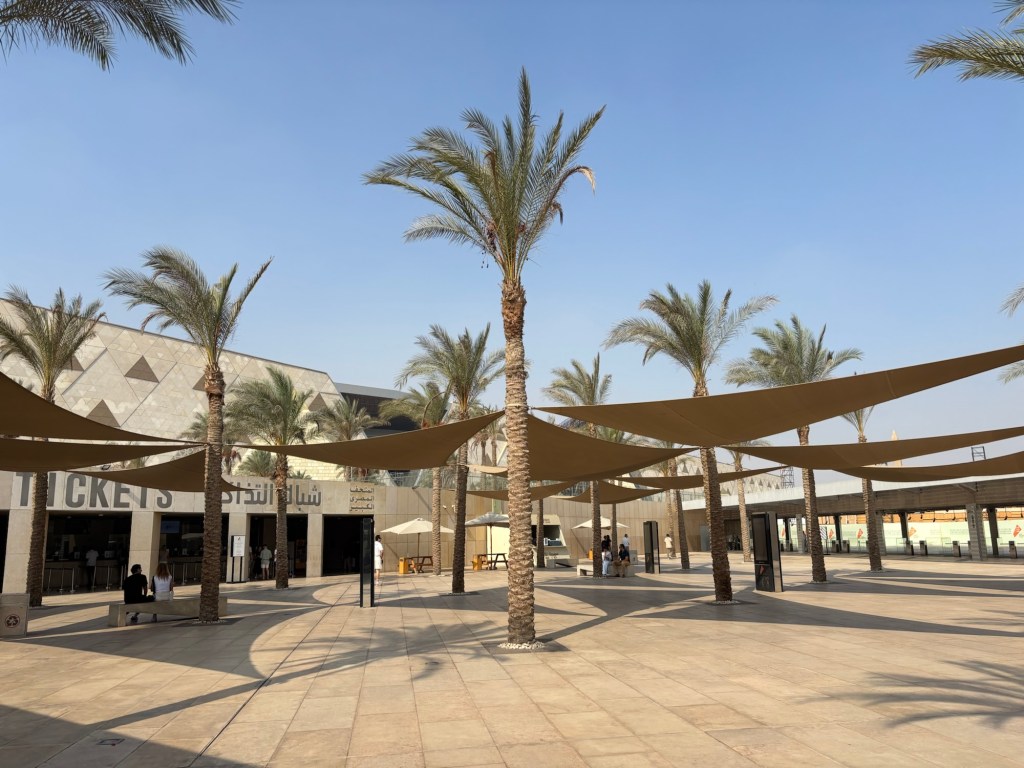
I arrived at a huge, diaphanous open-air space with ticket windows (I bought mine online, expensive for Cairo at around €20), drapes for shade, and palm trees, and some construction where the main plaza with a towering obelisk was still under construction (guys, there’s a deadline!). You don’t really see the building itself until you’re at the very door.
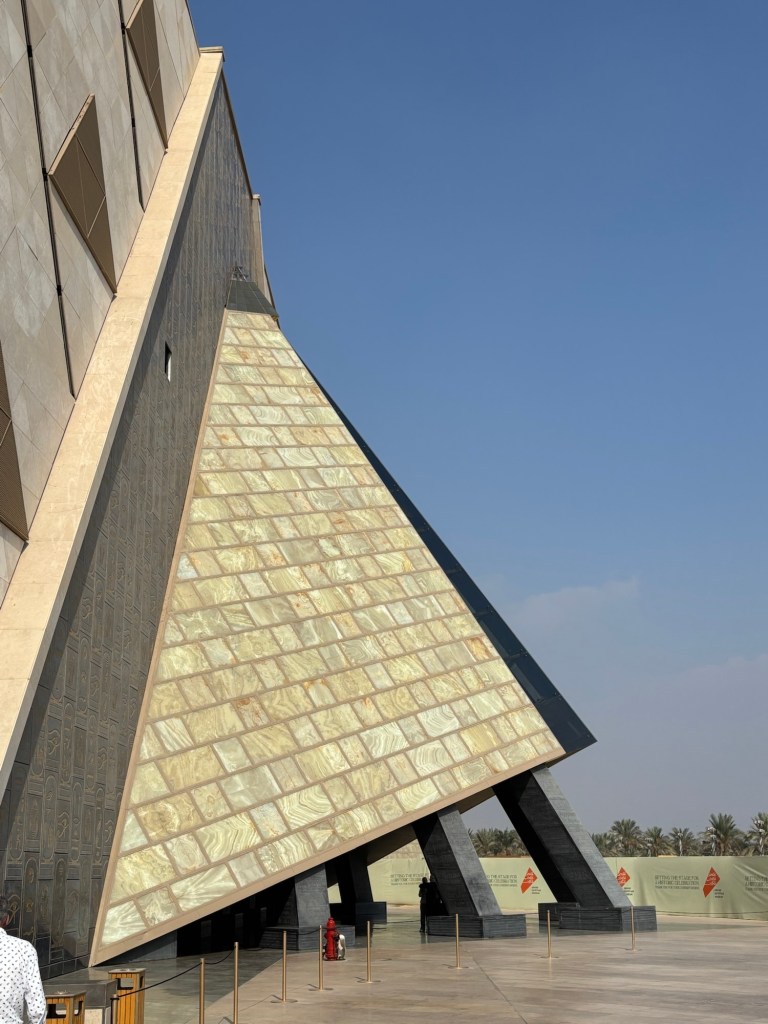
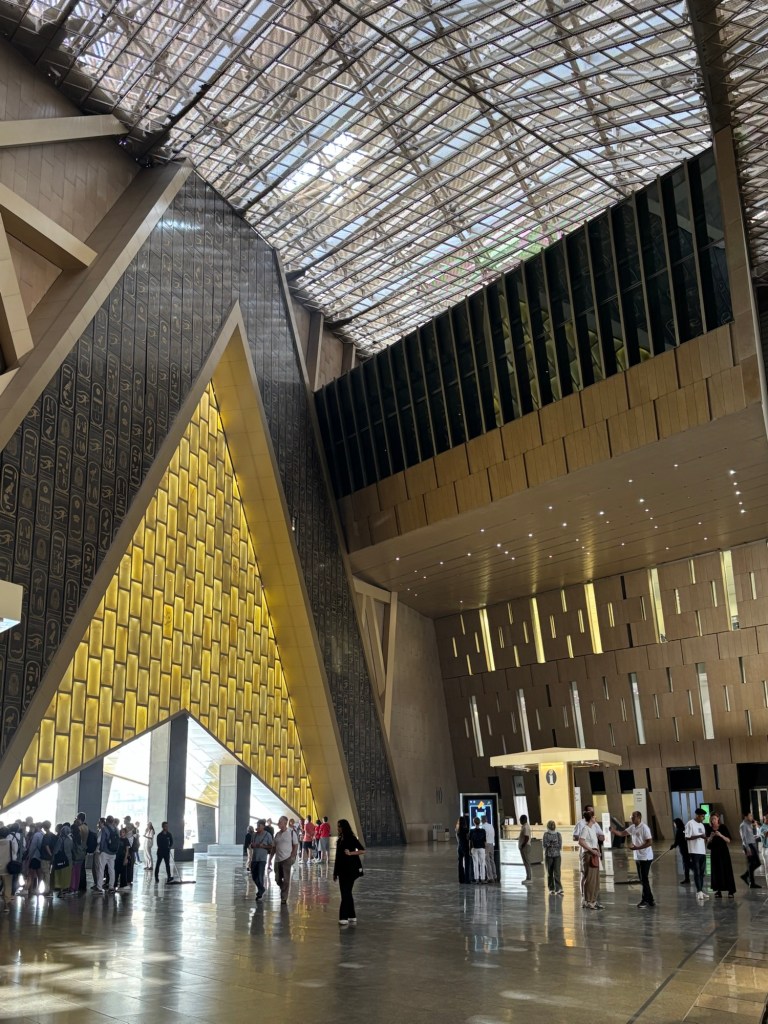
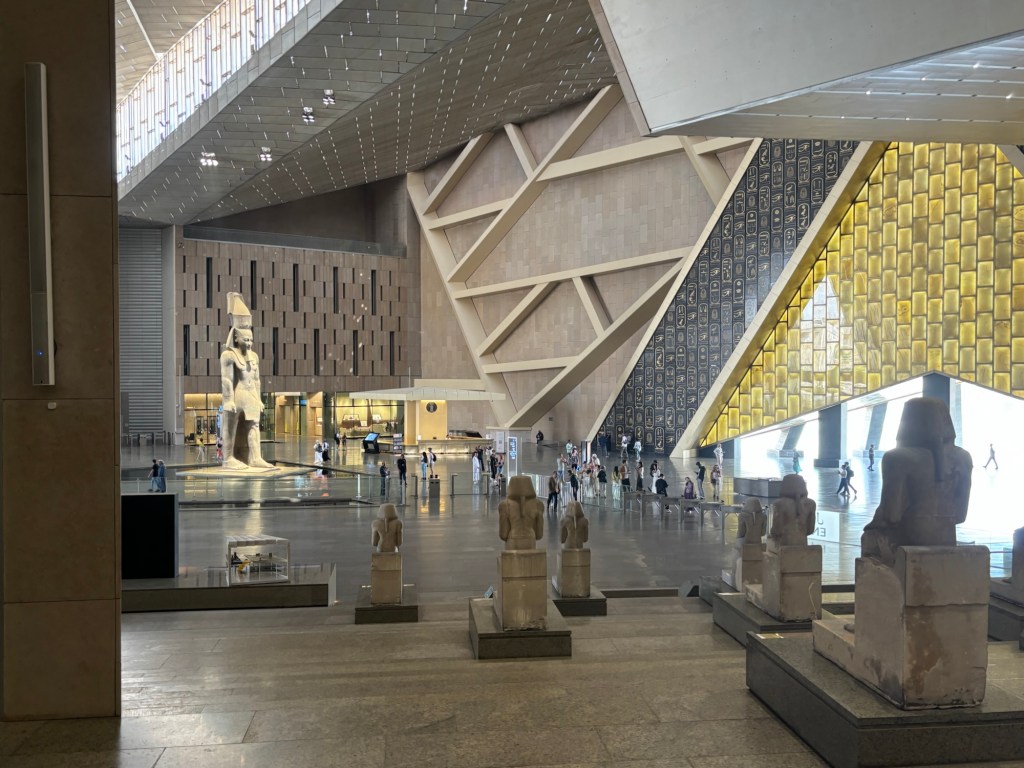
Once inside, I was blown away by the magnificence of the lobby, even though I’d seen pictures during my research. I love the materials used: the glass, steel and polished stone are unequivocally modern but their muted colors resemble the ancient sandstone and paints of the historical temples, and everywhere you look there are triangle shapes, sharp angles and contrasting features. Somehow, the millennia-old statues that dot the atrium look right at home in this bleeding-edge facility. After all, there is something timeless about the straight lines and colors of ancient Egyptian art, already evidenced by its influence in art deco.
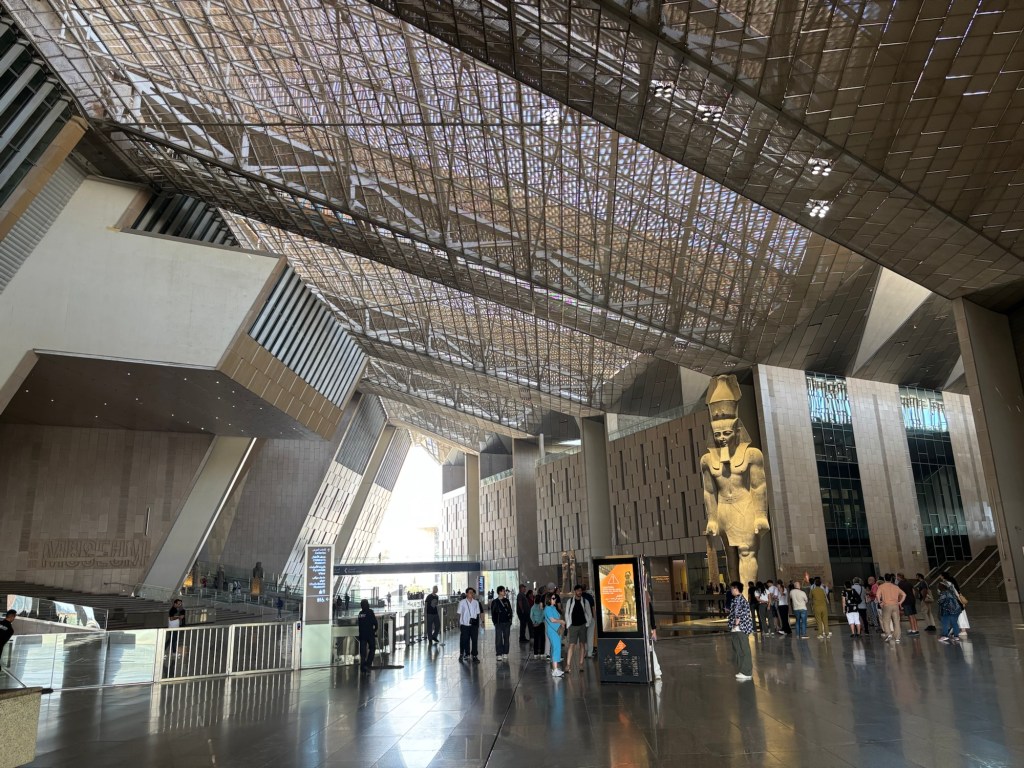
The complaints about some galleries being closed until inauguration and the huge but relatively empty atrium led me to believe that that was mostly it and I would spend my time gawking at the building itself (which I certainly did!) but after ascending the large staircase I was surprised to find a dozen different galleries at the top, arranged in a 3×4 grid, with an enormous collection of historical items.
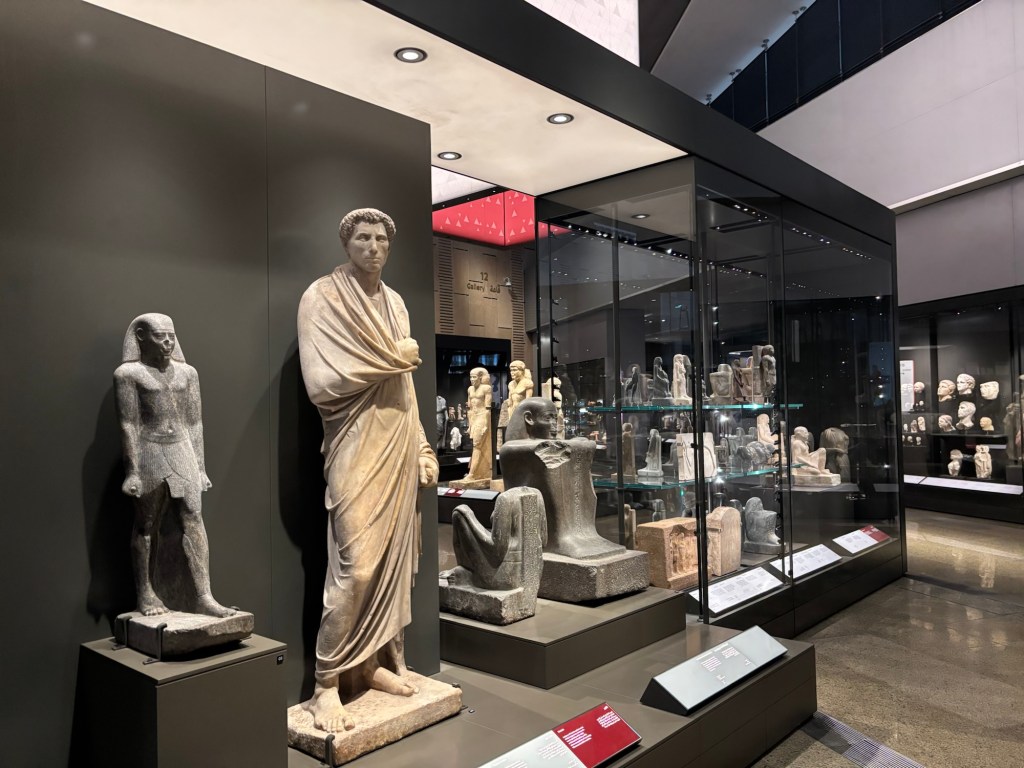
The statues and slabs of stone covered with hieroglyphs did not hold my attention very much, because at the tail end of the trip I’ve seen so many of them already; instead, I was most intrigued by things I hadn’t yet seen in any of our previous tours, like the bracelets, rings, and necklaces worn by pharaohs as well as nobles and priests. I’ve said this before here, but I like seeing ancient jewels because they feel so much more personal than monuments and official inscriptions: this is a bracelet that someone liked, and found pretty, not a deliberately projected communication into the future.

The museum was relatively busy, with some groups, some couples with their own guides, some visiting on their own like me, but all the rooms are so wide that I never had a sense of being crowded. The air conditioning was at the perfect temperature and there was a constant, soothing thread of traditional instrumental music playing softly in the background, all adding to a wonderful visit.
After having walked around for what felt like all morning admiring all the building’s features and then going back when I realized I forgot to check some of the actual exhibits, I stopped for a pick me up at one of the cafes -all very elegant… and a Starbucks- and then checked out the museum shop.
This, finally (finally!) was the kind of shop I wanted to see all along: instead of the ugly, plasticky or tinny mass-produced stuff they sell at the temples, the GEM shop carries tasteful accessories and homeware goods, things that are recognizably Egyptian without being tacky. It’s still an affordable, popular store, so it’s not like designer made or anything, but great for omiyage. Like I did last time in Japan, I went in determined to buy gifts for people and ended up buying stuff almost exclusively for myself. I’m the worst!
There came a point when I had to admit I was done seeing everything and had to go back to the city. I tried to call an Uber again but this time every driver I got insisted on being paid cash and canceled on me, so I ended up getting a regular cab for a predetermined fee and went back to the hotel to drop off my bag.
From there, it was a short five-minute walk to my next destination, the Egyptian Museum, the oldest and largest archeological museum in Africa. What I didn’t know is that the short five-minute walk around one corner would involve crossing not one but two separate six-lane highways full of cars with no crossings. I confess I felt a rush of adrenaline getting to employ my well practice Southeast Asian crossing skills. Vietnam was good practice because all the scooters drive really slow: here the cars all go by at high speed! Funnily enough though, when I was crossing the second highway a guy who went next to me said “You cross street like Egyptian!”… that made my day!
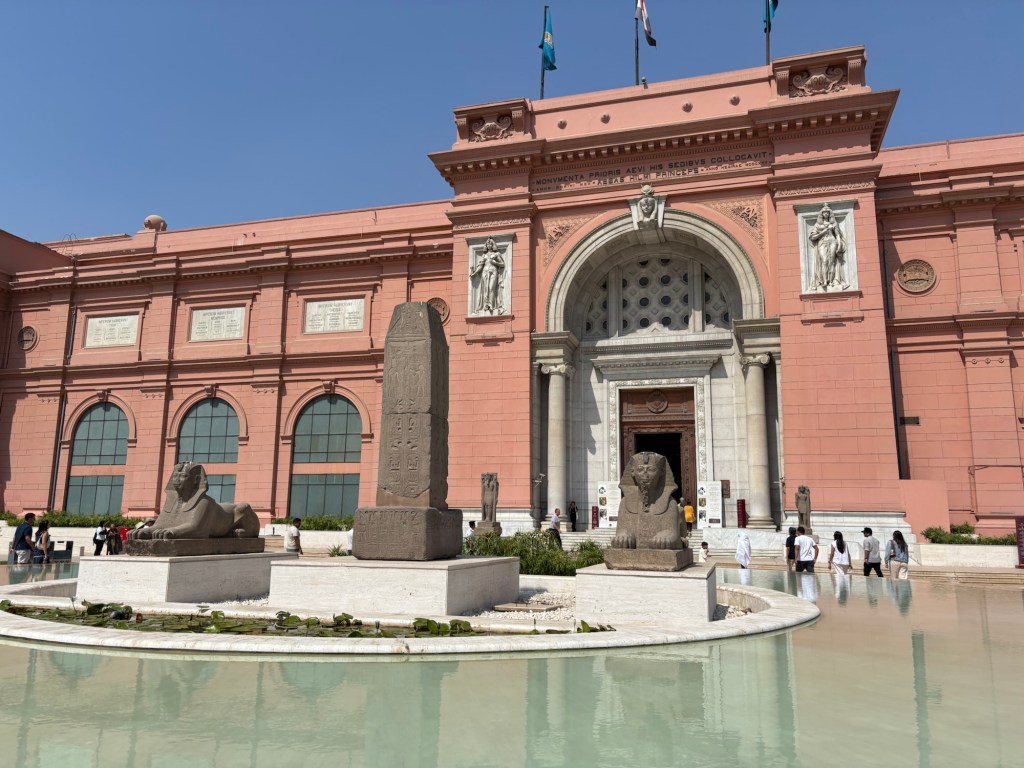
I got to the old museum last two o’clock in the afternoon, a bit late considering it closes at five with last entry at four. Despite the hour and the penchant of tour groups to start very early in the morning, I found it packed to the rafters with people, groups and individuals alike.
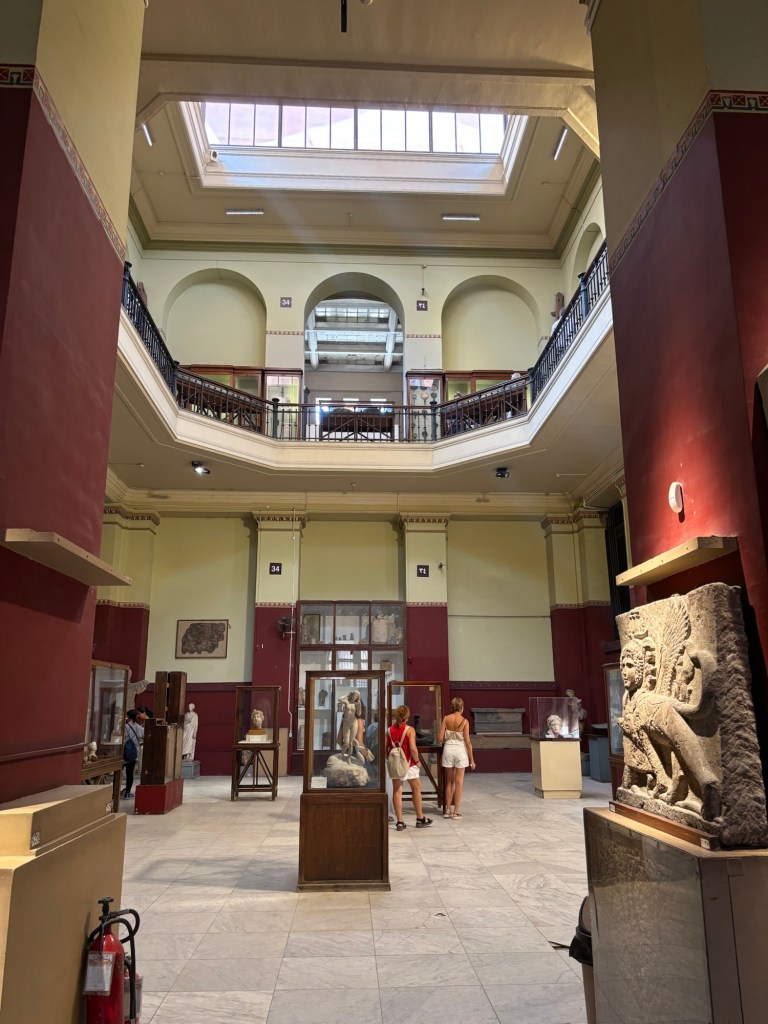
Maybe I should have seen this one first, because the comparison with the new museum is not kind. The building is old, as are the exhibits themselves: it’s wild to see priceless statues, thousands of years old, all presented without any kind of glass or protection, meaning there is a non-zero chance that some tourist has licked this bust of Tutmosis III! The wooden cabinets that display vases and scarabs are dark, the glasses almost frosted with age.

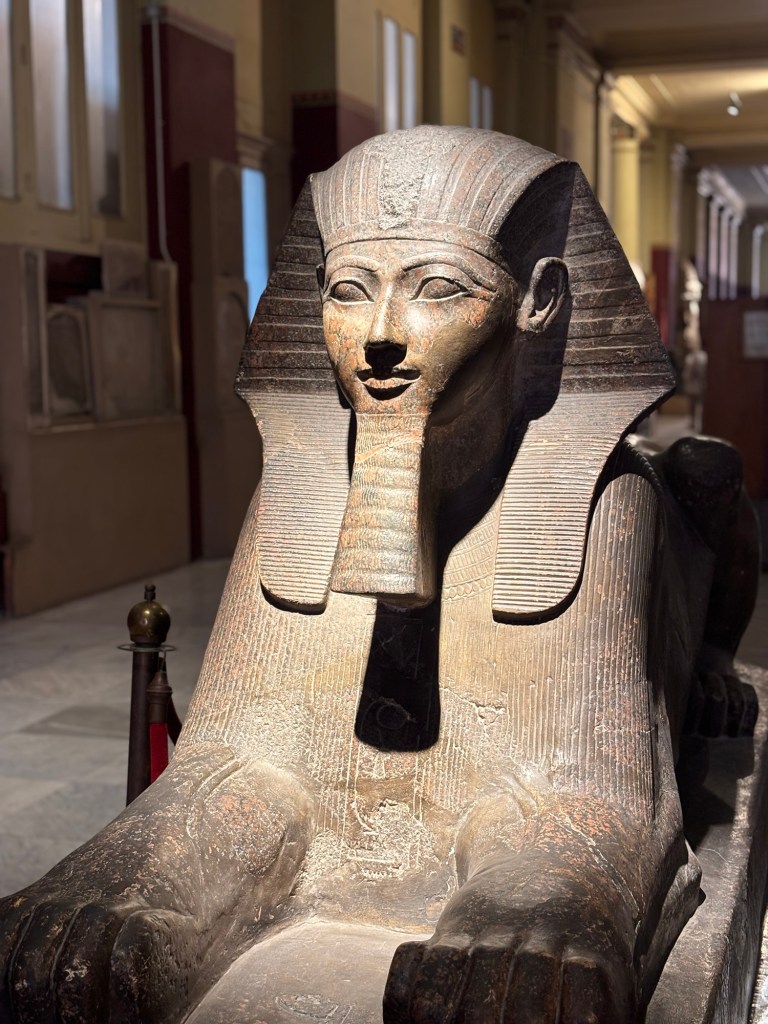
To make matters worse, about a third of the materials were all packed in wooden boxes, presumably to be transported over to the GEM ahead of the opening, so really the museum is not at its best right now. The items in it are of course historically very significant, but their presentation does not do them justice. I still enjoyed the visit, mind you, some of the sculptures here are better preserved and more finely detailed than anything else I’ve seen so far. I was particularly impressed by some busts that feature incredibly lifelike faces, ones that you could see on a person today. Isn’t it incredible that three thousand years ago we still looked the same?
The museum’s Crown Jewels, at least for now, is the Tutankhamun exhibit, kept in a separate gallery where photography is unfortunately prohibited. Tutankhamun, the person, was not historically that significant: he acceded the throne as a child in a period of wars and died at only 19. He is significant to us because his tomb was famously discovered almost intact (apparently it was visited by robbers shortly after it was built, then never again) by Howard Carter in 1922, so it is the closest we can get to seeing what pharaonic tombs were really like.

His famous golden mask, the archetype through which we now imagine pharaohs, and his golden inlaid sarcophagus are a showcase of craft and refinement that are well worth the entry ticket. I noted that the literature accompanying the exhibition made a point of criticizing that Carter’s accounts downplayed the role of his Egyptian workforce.
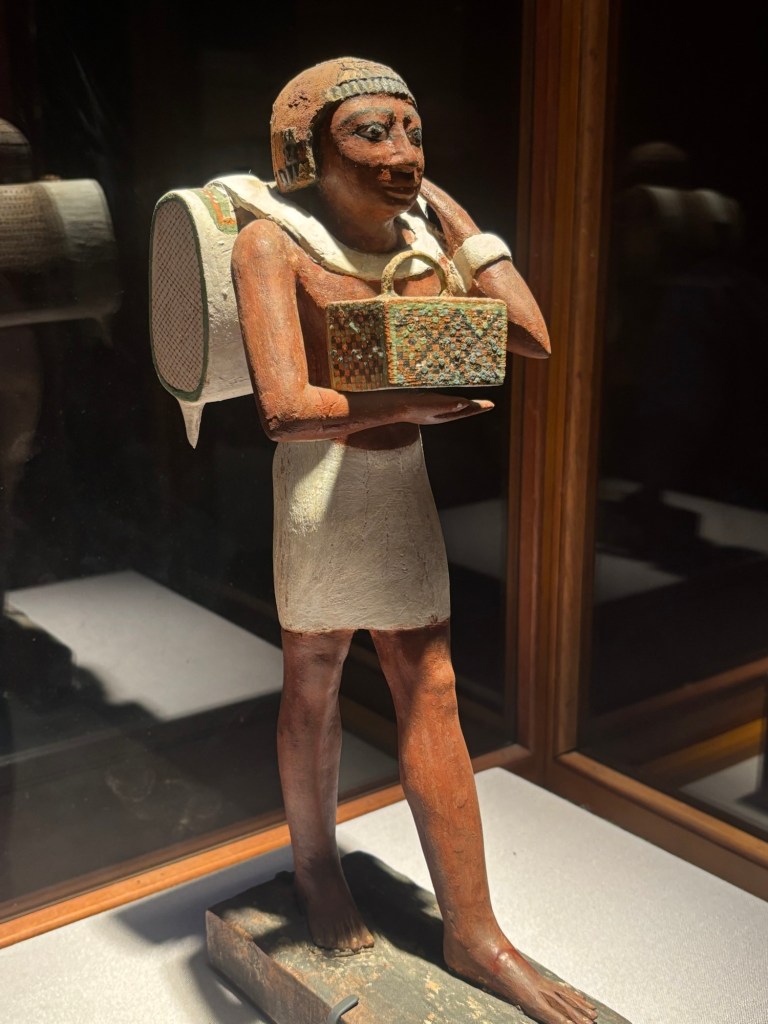
I was charmed by this little fella, who according to the explanatory note, is the first recorded depiction of a backpack:
So… I had that stretch goal of going to see Al-Azhar Mosque, as a way of getting to see something of Cairo city proper: I have the feeling that I haven’t really “been” in the city, having seen only the Pyramids and the museums but not the experience of walking around or seeing the inner monuments. But, by the time I finished at the Egyptian Museum it was around three and a half in the afternoon, I was exhausted, online search results suggested the mosque closed to visitors at four or five, plus the idea of having to negotiate cab fares to get there and back… it was looking like a less and less achievable objective, so instead I retreated into my swanky hotel and treated myself to a swim in the terrace pool and a tea and biscuits in my balcony while I write these lines. I may not be able to say that I’ve really known Cairo but I can say I had a grand old time!
That’s Egypt wrapped for me, then. Like I said before, the organized trip experience isn’t for me -I am so tired!- but there’s also no way I could have done this trip by myself, so I’m so happy that I came. It’s been an incredible experience filled with so much history and wonder. Seeing the pyramids was a bucket list item, visiting the ages old temples of the Nile was transporting, and getting an exclusive first look at the Grand Egyptian Museum today was such a cool experience! I am going to need several weeks to recover, but I’ve made great memories along the way.

 This Is A Lake