
When I woke up this morning -at seven, an hour that felt like 11AM after the last couple of days and what awaits me tomorrow- we were docked in Aswan, the capital of Southern Egypt, the gateway to the desert and the Nubian civilization, and the last leg of our Nile cruise before we fly north to Cairo.
Our main mission for today was to visit the Temple of Philae, a storied temple that was built two thousand years ago, during the reign of the Greek pharaohs, in honor of Isis, the most revered Egyptian goddess. It is notable because it was built on an island in the middle of the Nile, but listen to this: when the Nile dams were built, in 1902, the water levels rose and flooded the temple in such a way that more than half of it stayed underwater for the next seventy or so years, at which point it was disassembled from the now submerged Philae island into 40,000 blocks and reassembled on the island of Agilkia, just a few meters away, where it now sits. So, proportionately to its chronology, the Temple of Philae has only been at its current location for the blink of an eye!
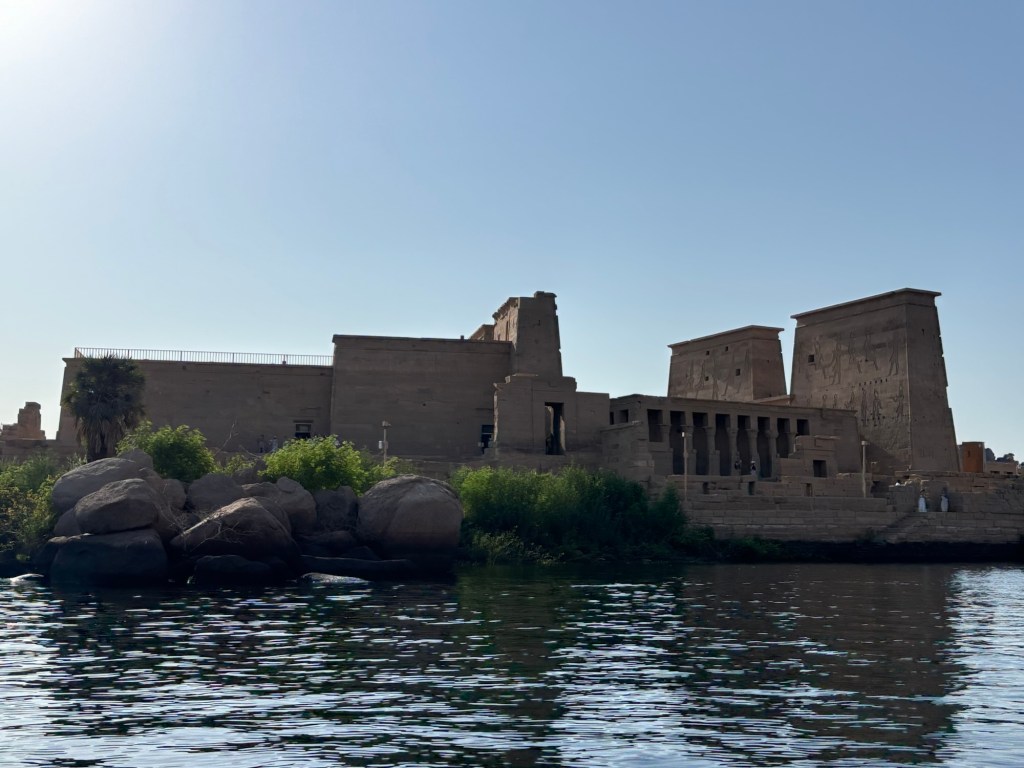
To get there, we had to get on a van and ride for a while to get to a different dock, and then board a small boat to take us to the island. Here again I have no idea how I would have managed to make this visit on my own; obviously I could take a cab or carriage to the dock, but then the tour guides and agencies all jockey for the constantly departing boats while touts try to sell their souvenirs and it must be a nightmare to try to bargain for a ride there. The boat ride is short, but it’s nice to get on the water, even if the temple isn’t really visible from the lake during approach until you’re almost there.
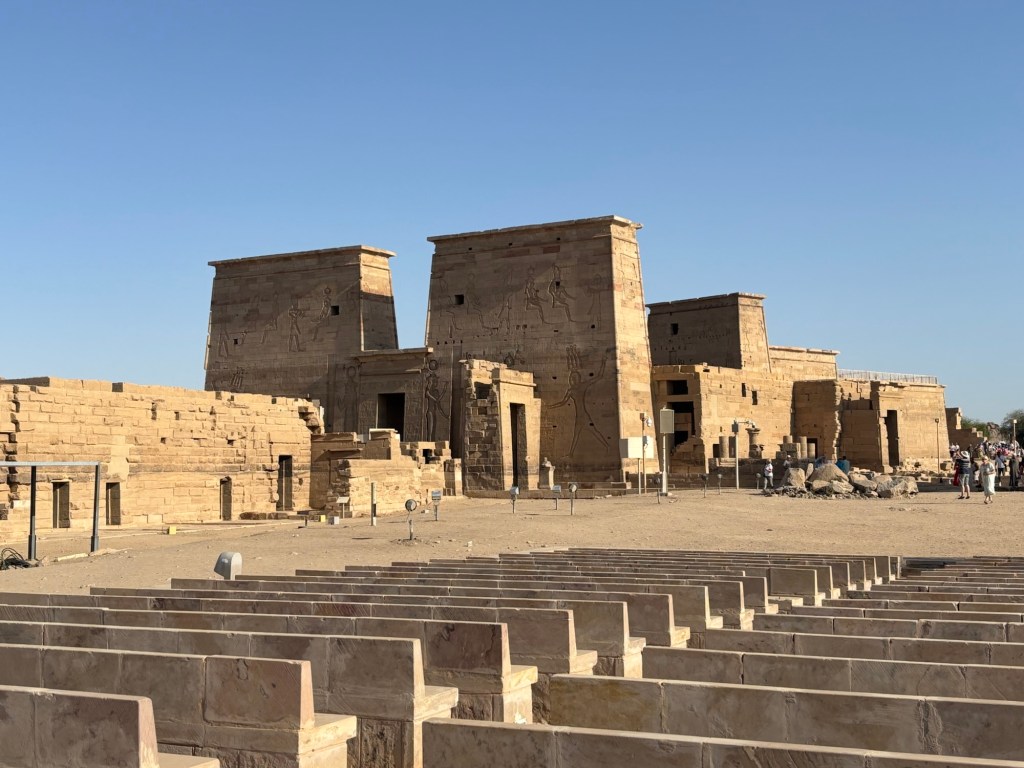
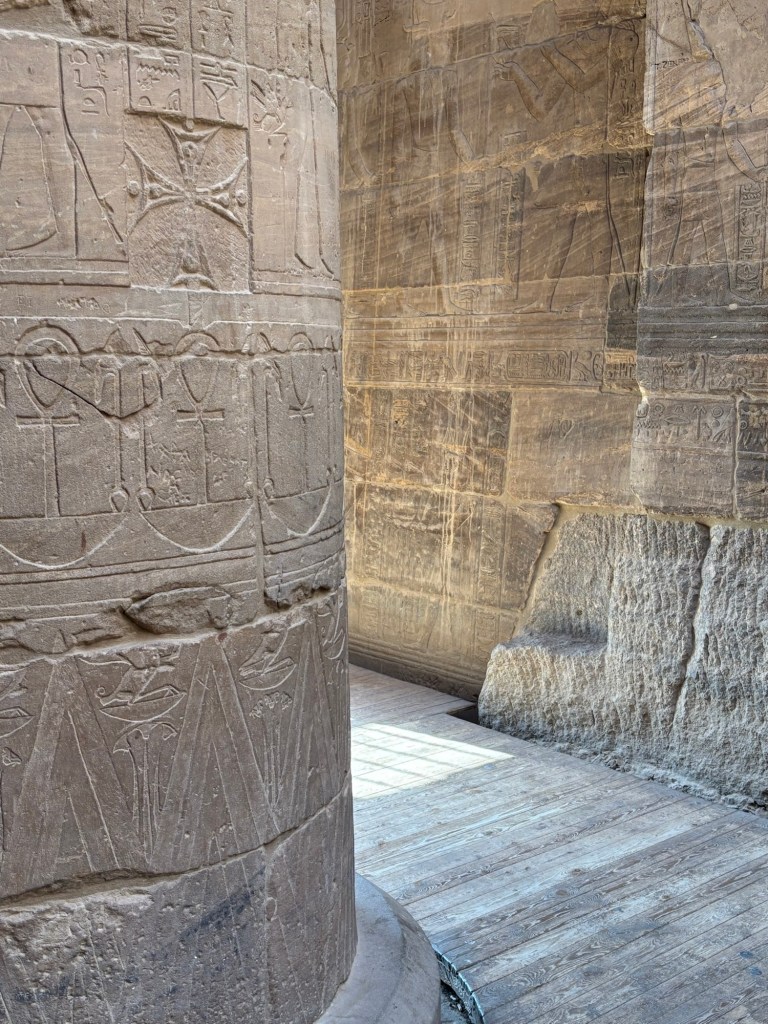
The temple is well worth the visit for its picturesque location as well as the beauty of the ruins themselves. Most columns have ornate flowery crowns, all different from each other, and there are rooms in the interior that have preserved their meticulous inscriptions. Like many other temples in Egypt, this temple was eventually inhabited by Christians who routinely defaced (literally scratched the face off) all representations of Egyptian deities, who remain recognizable by their silhouette and headgear. In Philae, however, the Christians not only lived but turned the temple into their own place of worship, as attested by the many Greek crosses carved onto the stone.

There are also traces of the Roman reign around the island, namely the arches or shrines built under emperors Trajan and Hadrian.
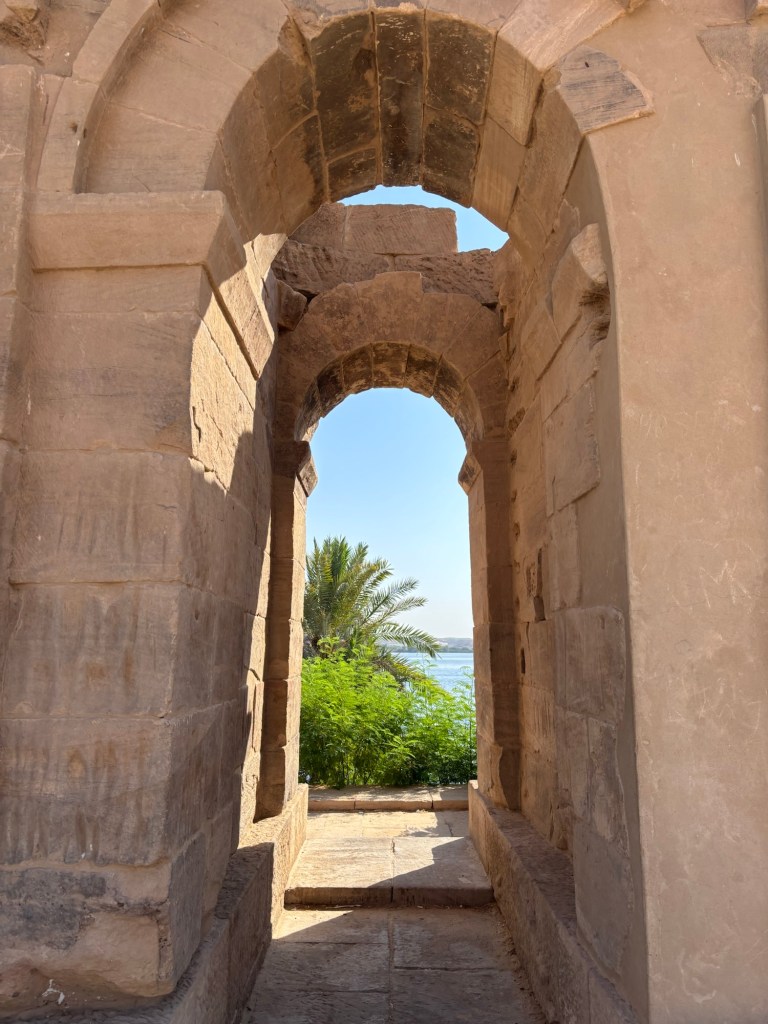
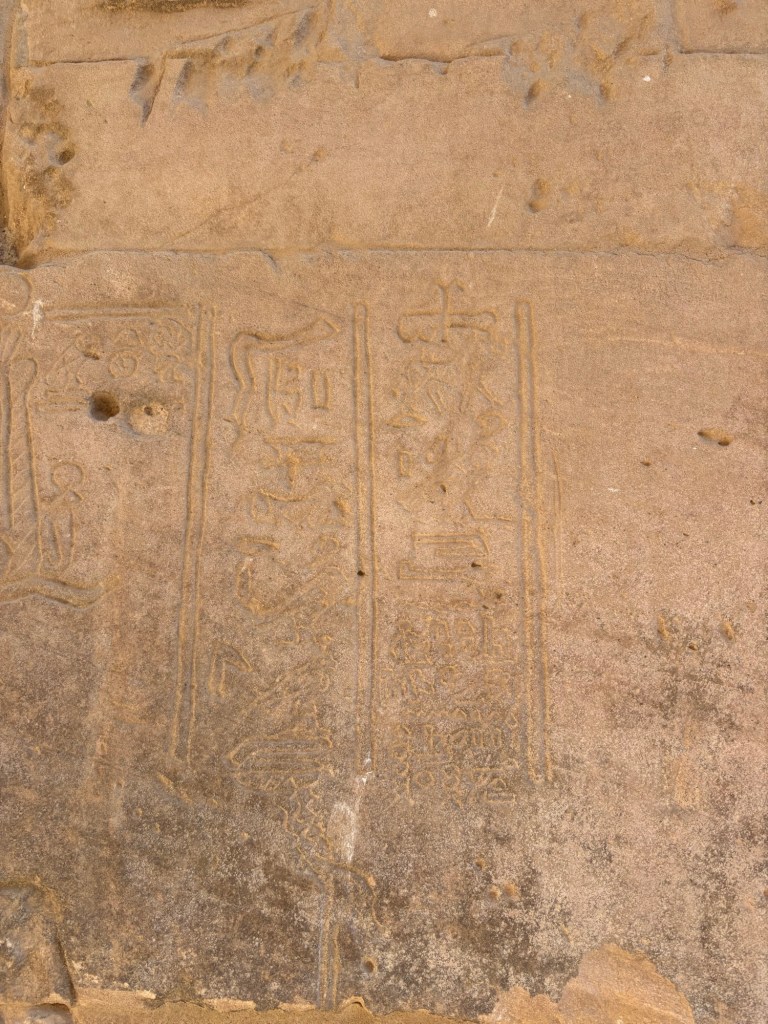
Another thing that piqued my interest: in one of these shrines is the last known use of hieroglyphs, an inscription made by a priest in the 4th century CE. I had never stopped to think that, just like there is a first recorded use of an alphabet or language, there can also be the last…
The sun hit pretty hard already at ten in the morning, but it was still a pleasure to walk around the compact temple grounds, peeking into different shrines and finding new perspectives looking out into the water. There were cats lazily strolling around the outside, paying no heed to the many groups of tourists taking pictures all around them.

Inside, there are reliefs of Isis everywhere, but also of Hathor, the wife of Horus, who is represented with the ears of a cow. There’s a room that was used to store precious perfumes, and in it a faint scent lingered in the air, which means either some tourist had a powerful aroma or someone is employed to periodically douse the perfume room!
Eventually we made it back to the boat, and then to the docks, and then to our van, which took us to not one but two shakedowns: one was a perfume store, where we sampled several traditional Aswan scents (papyrus is too strong for my taste, but lotus smells really nice), and a spice store, where they recommended Iranian saffron. They are cunning salespeople behind their hospitality and offerings of karkadai, a cold hibiscus tea, and I ended up overspending at the spice store (what was supposed to be 100g ended up being closer to 200g), but that’s gonna be most of my omiyage sorted: the souvenirs they sell at temples are mostly tin or plastic and look cheap, and the good thing about spices is I can split them into several batches to give to multiple people… while keeping some for myself!
In the afternoon, they took us on a falucca ride, a falucca being a traditional sailboat, on what turned out to be a bit of a waste of time. I thought at least we’d go up and down the river but we just went out to the middle, hovered there for a while, then sailed back to our boat. Being out in the water and feeling the breeze was nice but I hoped for more!

We had the option now of going on an excursion to a Nubian village, but it sounded awfully touristy and fake, so I and most of our group passed on it and decided to rest until the evening excursion into the city. I briefly considered going out into town on my own but the allure of my room was too powerful! I should be able to do some adventuring by myself on Sunday, when we have a full free day in Cairo.
At around 19:30, after nightfall, we set out into a cab to drive into the city proper. Our first stop was a Coptic Church, an oddly modern building for a site that I think was originally much older, The inside looked a bit like a Catholic church through an Orthodox lens, and I noticed that all the men sat on the left side of the aisle and all the women sat on the right. We arrived in the middle of a service, observed quietly for a bit, then went back outside.

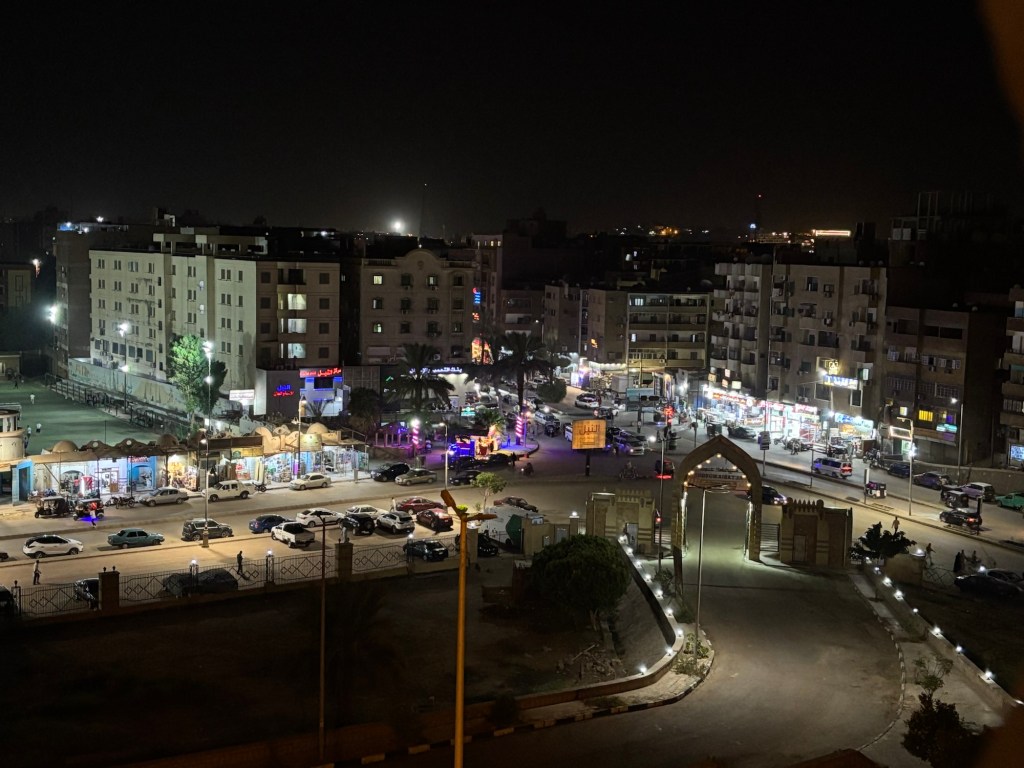
As I looked out at the streets, trying to picture myself walking along them if I was going out alone, I began to form the conclusion that in terms of economic development (the sidewalks, the roads, the traffic, the shops, the state of the houses and buildings, and so on) what I’ve seen of Egypt so far appears to be on par with India, but on an experiential level I get the feeling that India is way more tourist-ready: yes, the traffic is crazy and people try to sell you stuff and the roads are in disrepair, but in India you still see restaurants or cafes or shops that clearly see foreigners or domestic tourists, cabs and tuktuks, and other services that make traveling easier. That seems to not exist here, even though Aswan is a major tourist destination, probably because all travel is concentrated in tour groups that never really seep into the city.
We then made it to a mosque sitting on top of a hill. Here too they were in the middle of praying when we arrived; apparently they had just officiated an engagement, because periodically shrieks of celebration emerged from the women’s partitioned section. To my horror, our guide made us intrude (discretely, through the back) into their partition to sneak into the stairs to the rooftop. The women there looked more amused than anything else at my apologetic nods as I scurried away.

From its vantage point, the mosque enjoys a 360º view of the whole city, now teeming with people that were waiting for the brutal sun to set to go out and run their errands. The shops here stays open until one in the morning during the hot seasons, because that’s when it’s possible to be outside without bursting into flames.
Lastly, we stopped to try sugarcane juice, you know the kind, that one where they take entire sugar canes and feed them into a big grinder machine that presses all the water out of it. The resulting drink was very refreshing and way less sweet than I expected!
We arrived back in our cruise ship past dinner time, but they begrudgingly let us have our dinner before sending us on our way. I was happy to eat as fast as possible because I have to pack my bag and also get ready for a very early day tomorrow, as we have to go all the way to Abu Simbel (a 3h+ drive) and back before boarding our flight to Cairo in the evening. I guess I’ll rest when I get back home!

 This Is A Lake