
Nothing like an intense day of traveling to appreciate a good night’s sleep! Last night our ship docked at Esna at around 7:30PM to cross the locks, and imagine how much traffic there is on the Nile that we didn’t get to cross until one in the morning -I was obviously fast asleep, woke up at the sound of the machinery, then fell asleep again immediately.
Today we got up objectively early but it felt almost decadent in comparison to yesterday. At some point during the night we arrived in Edfu, our next destination, and after a sleepy breakfast we set out to visit the famous Temple of Edfu. The ride was short, and no wonder, because our driver drove the van like he was in a high octane chase scene in an action movie, including invading the opposite lane to overtake the many horse-drawn carriages transporting tourists and locals alike. Road signs and traffic lights are nonexistent, much like in India or Thailand, so you have to steel yourself whenever you get on the road!

Edfu temple, then, built all of 2,300 years ago, is notable for being the best preserved temple in Egypt thanks to having been buried in sand for centuries. It was constructed in honor of the god Horus (the one with the head of a hawk), son of Isis and Osiris, and more specifically to celebrate his victory over his uncle, Seth, in revenge for Seth’s murder of Horus’ father (this is, not for nothing, the plot of Hamlet). Horus destroyed Seth, his mother Isis mummified the dead Osiris, and then Osiris resurrected, thus illustrating a good section of the ancient Egyptians’ religion and cosmology around life and death.
The outer wall leads into a beautiful courtyard surrounded by columns representing papyrus, lotus and palm flowers, open at the top. The bases of the columns are painted with water at the bottom, then plants, then animals, and then humans, following the hierarchy of the world.

If I thought Karnak and Luxor were imposing and well preserved, that was nothing compared to Edfu. The temple itself is smaller, but it really feels like it’s standing almost entirely like it was two millennia ago. Beyond the intact pylon at the entrance, showcasing engravings of all the deities above and then some, the interior walls, columns and even ceilings all stand tall and conserve countless hieroglyphs and illustrations of myths, historical accounts, royal elegies and anything else that needed documenting.
According to our guide, Edfu temple was a key center in the design and manufacture of perfume, a valuable product at the time that was coveted by (and eventually made its way to) many other countries around the world.
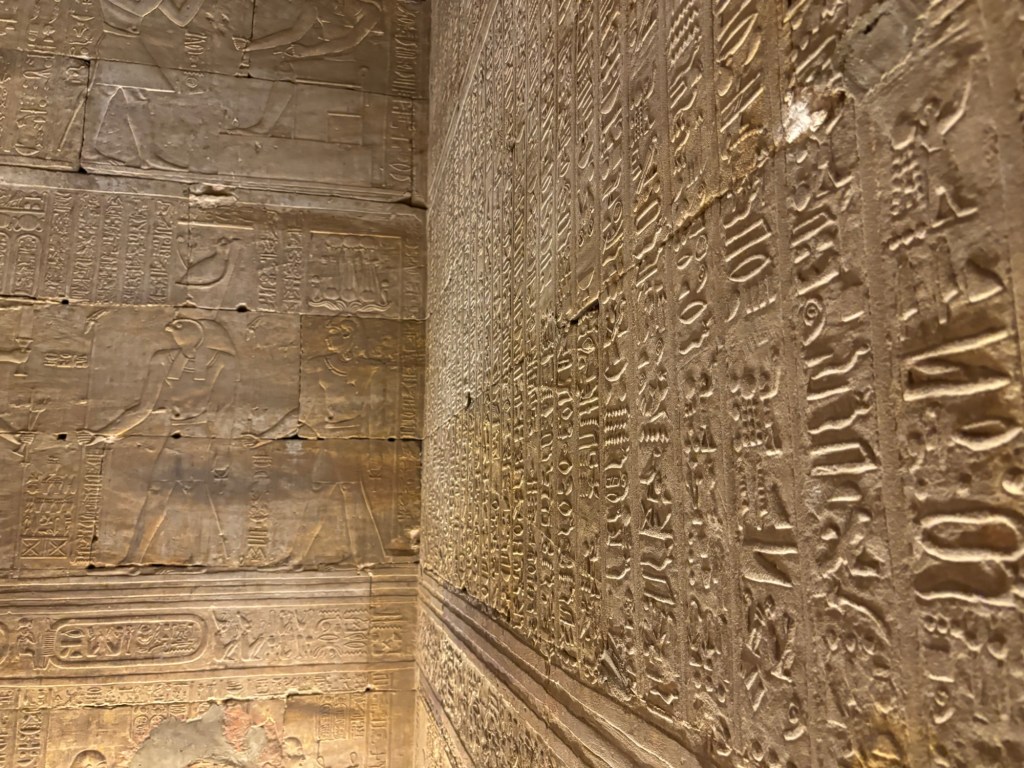
Seeing columns and walls is one thing. Walking through the narrow halls of an ancient temple, peeking at the ornate chambers that open to either side or stepping out into the outer perimeter, is quite another. Here you don’t have to guess as to what the structure would have looked like because it’s all right there!

The weather wasn’t nearly as hot and oppressive as it was yesterday, even though on paper Edfu had the same forecast, but on the other hand it was crowded to capacity: on the outside people could spread out a little more, but the hypostyle hall and the corridors were packed wall to wall with tourists (including me, there being part of the problem!), of which 75% must have been Spanish (including me, there being part of the problem!). This was the first time the crowds became annoying, because the corridors are so narrow that roadblocks became inevitable and it was impossible to take decent pictures without aiming fully upwards (one time I did that I found a room that had dozens of tiny bats hanging from the ceiling).

This temple is more recent -as weird as it is to apply that word to a building that was three hundred years old when Cleopatra was born- but the weight of history feels even more prevalent there. It’s easier to imagine it as a functioning place of worship, there’s the mythology primer present in every wall, pillar and square centimeter of stone, and little details that reveal unexpected historical insights. For example, our guide pointed out a blank cartouche in one wall, where normally they would have engraved the name of the pharaoh: well, turns out during the reign of the Greek pharaohs news took years to travel from Low Egypt (the north, because it’s at sea level) to High Egypt (the south, at higher altitude), so the people at this temple quite simply didn’t know who their current king was and must have thought “Eh, we’ll fill this in later”.
We made it back to our ship at around 10:30 and set sail to our next stop. I appreciated the split itinerary, much better to rest a little between visits than the seven-hour gauntlet we ran yesterday. The cruise life is definitely not for me -I would not have chosen this if there was any feasible way to do this trip by myself- but it’s nice to look at the palm trees and the desert on either bank of the Nile.

We got ashore in the afternoon again and caught a ride to the Temple of Kom Ombo, this one dedicated to Sobek, the crocodile god (our guide informed us that there are no crocodiles in the Nile anymore, because they cannot get past the locks).
We eventually docked at Kom Ombo, disembarked, and to my surprise the temple turned out to be literally just up a few steps from the docks, so instead of the wild ride that I was bracing myself for it took us a few minutes’ walk to find ourselves scanning our tickets at the entrance. Like in all Egyptian temples so far, there’s a bit of security theater at play, where you have to put your backpack through an X-Ray machine and walk through metal detectors like at an airport, but I say it’s theater because the detectors always beep (nobody takes out their phone or keys or anything) and nobody bats an eye, not even when people decide to walk right through with their backpacks and everything…
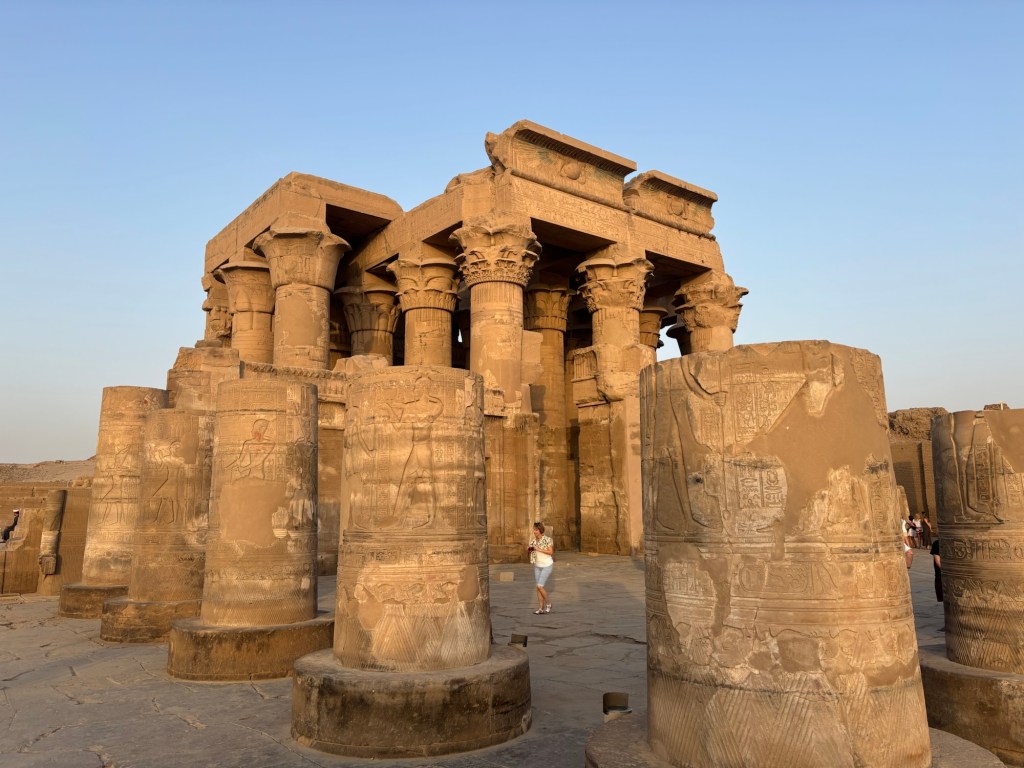
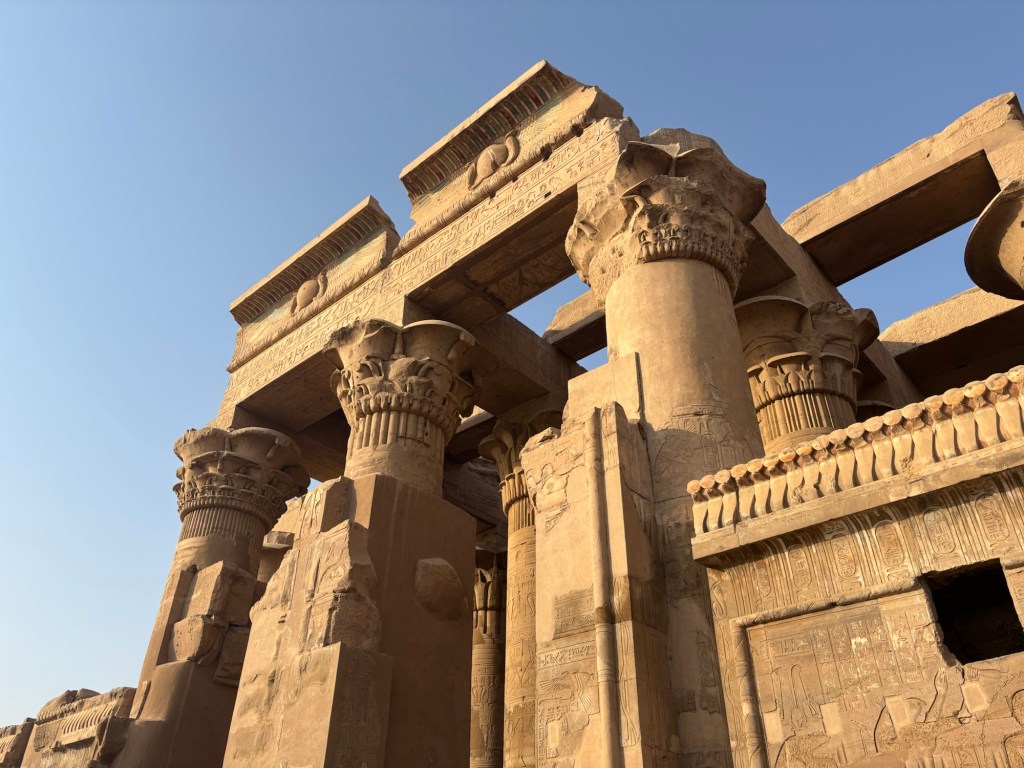
The small temple of Kom Ombo (a name that meant “city of gold”), built around 2,300 years ago, is notable for being the only fully symmetrical temple in Egypt, and that’s because it’s also the only temple built to worship two different gods simultaneously -I suppose each one got an equal half in the custody agreement! One is for Horus the Elder, not to be confused with Horus Jr. from the temple that I visited at Edfu this morning, and the other is Sobek, the one with the head of a crocodile. Our guide told us that Horus was the god of the farmers and Sobek was the god of the rich and noble, so their joint temple was a sort of peace agreement between the landowners and the workers who toiled in them.
This too was fairly crowded, but due to the state of the ruins all of it is technically outdoors, so it didn’t feel as cramped and it was easy to spread out or step away whenever a lot of people congregated around an artefact. Here too there were a lot of columns with faded -but originally vibrant and colorful- friezes depicting multiple deities, edicts and historical episodes.
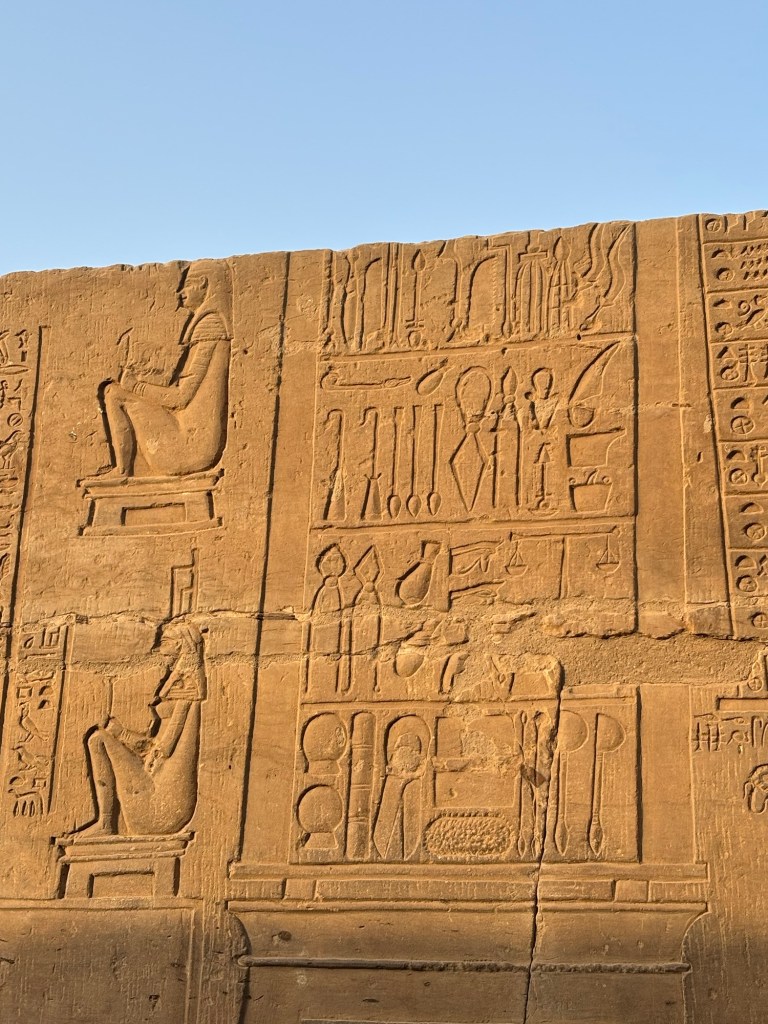
One tidbit that caught my interest is that there’s a diagram on one wall that lists all the surgical instruments that were used in ancient Egypt, next to the illustration of two women giving birth in a squatting position. One can imagine the historical value of finding this statement from two thousand years ago, but at the same time it’s terrifying to think that, while Egyptian medicine was incredibly advanced at the time compared to the rest of the world, there’s still so little that physicians back then would have been able to do for most maladies and injuries. Back then there was no real distinction between religion and medicine, and people went to the temple to receive healthcare. How far we’ve come! What medical practices today will be considered barbaric in the future?
There’s also a harvest calendar in a different section that explained in what week of the year people were supposed to sow or harvest different crops. Probably also historically significant but didn’t catch my interest the same way!
By the time our guide finished the tour it was around six, and the sun was already setting. The golden light of dusk gave a beautiful warm glow to the sandstone, and the long shadows highlighted the bas-reliefs even further, in a way that I don’t think the pictures quite do justice to, but which made for an enchanting magic hour feeling. And sort of unrelated, I began to smell smoke in the air, as if they were burning hay somewhere nearby, which triggered sensory memories of India for me, because -as you can read on this blog- when I visited it was during the air quality crisis of 2019 and the streets of Delhi had that smell the whole time.
After some free time taking pictures here and there, we walked out of the temple precinct, with the peculiarity that where other places have an “exit through the gift shop”, Kom Ombo has… an “exit through the mummified crocodile museum”. Sure enough, crocodiles being an object of worship at the crocodile temple, the community here embalmed and mummified crocodiles just like they did cats in other areas, and a dozen or so of them are exposed in a dimly lit hall next to some explanations. I learned that crocodiles were considered benevolent and violent at the same time, in true dual nature. The aggression is self-explanatory, but the benevolence comes from the fact that apparently ancient Egyptians were able to predict how high the Nile would rise by observing the behavior of the crocodiles, who always nested above water levels.

That was it, then, for day two of the four-day cruise. The archaeological wonders are out of this world but the earthly delights could be improved: the WiFi is down more than it is up, the data on my phone works only sporadically when we’re on the move, and I’m already longing for real food. Today I frantically booked tickets for a West End play with Ralph Fiennes on my phone while praying to Horus Jr. and Horus Sr. to not drop my connection until I was done, and my prayers were answered… but perhaps by Sobek the dual-natured, because I did successfully book great tickets, but my connection did drop shortly afterwards!

 This Is A Lake