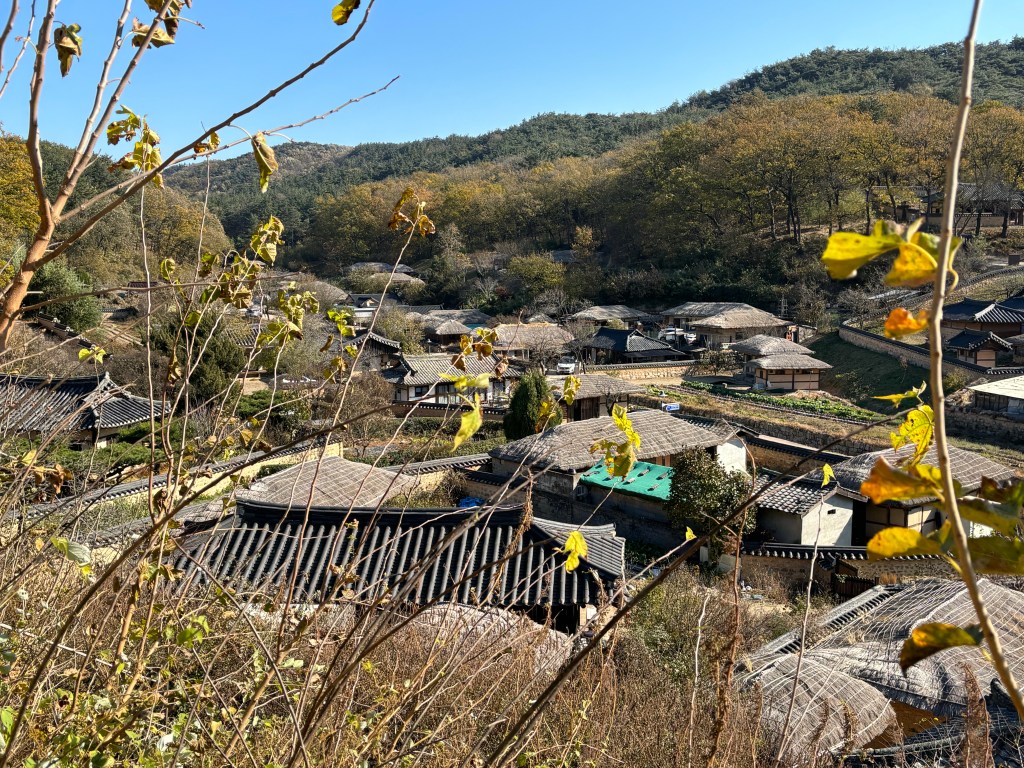
Today’s morning plan was another out-of-town excursion: this one to Yangdong Folk Village, a Joseon-era village north of Gyeongju that is famous for its preserved thatched-roof houses.
There are a bunch of buses that connect the Gyeongju bus terminal with Yangdong, but I discovered in shock that their frequency is… once every three hours! I almost thought my plan was gone but after some frantic research I came to the conclusion that the buses stagger their departures so there’s usually a half hour at most between them. Thankfully, I didn’t have to wait long to get on the 10:00 bus.
I was the only one at the bus stop, and for most of the ride I was fully alone on the bus. The driver skipped a lot of stops, such that a trip that my guidebook says takes up to an hour was over in barely 40 min. That was good! Not so good, finding that my stop was a tiny concrete patch in the middle of a highway:

The guide had already warned me that there is a path that runs parallel to the road, so I knew where to go, but while I walked there, alone in the middle of nowhere, lashed by vicious, freezing winds, I couldn’t help thinking: “What if it’s all an elaborate scam? What if there’s simply no village and this path ends at an empty field? How will I get back?!”.
Fortunately, the Yangdong village exists, as I soon walked into the parking lot, where a very nice guard directed me to the main gate where I bought a ticket for 4,000 won (€2.83). Here, finally, there were other people, but maybe ten total across the entire area. It’s clear that there’s a huge disparity in affluence between the central Gyeongju sights and the further ones.
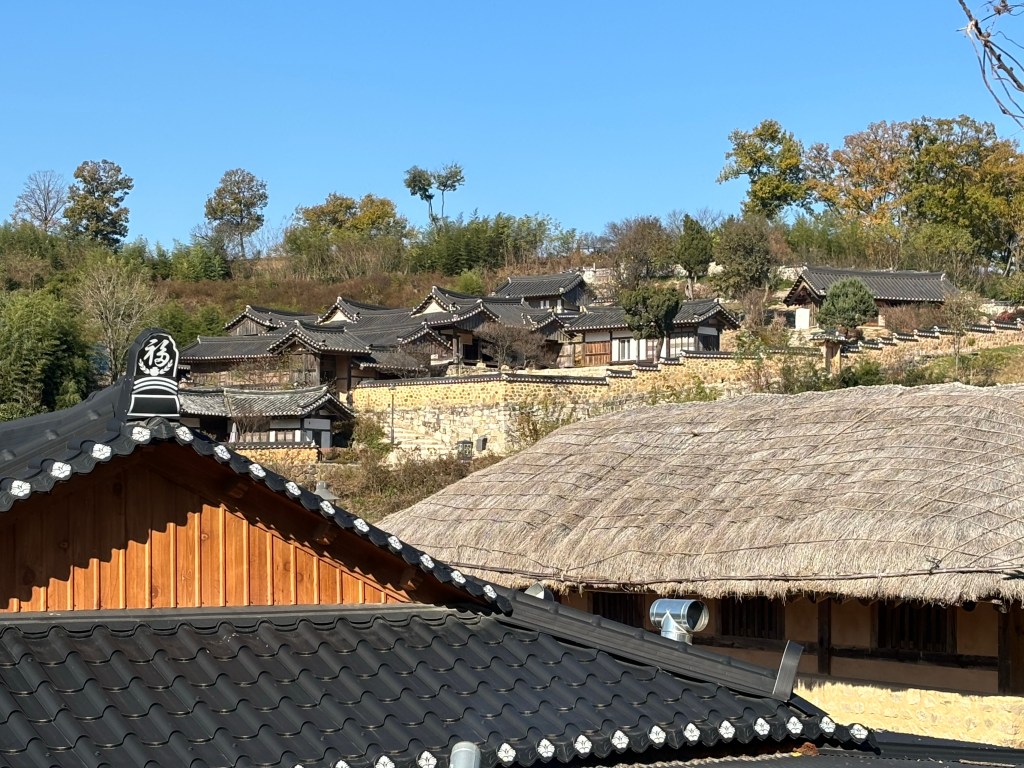
Two things to understand about Yangdong: first, it is a centuries-old town, which is laid out as a town, with various houses up on hills and down by valleys, so there’s no single route to follow. Second, it has been continuously inhabited since the 18th century, so the locals continue to live their lives and go about their business, which means that some notable buildings are sometimes closed when the family that lives there is busy. This makes the visit slightly confusing, because there’s no main street to follow, but to the town hall’s credit they have signs at practically every intersection with arrows pointing at all the nearby buildings.
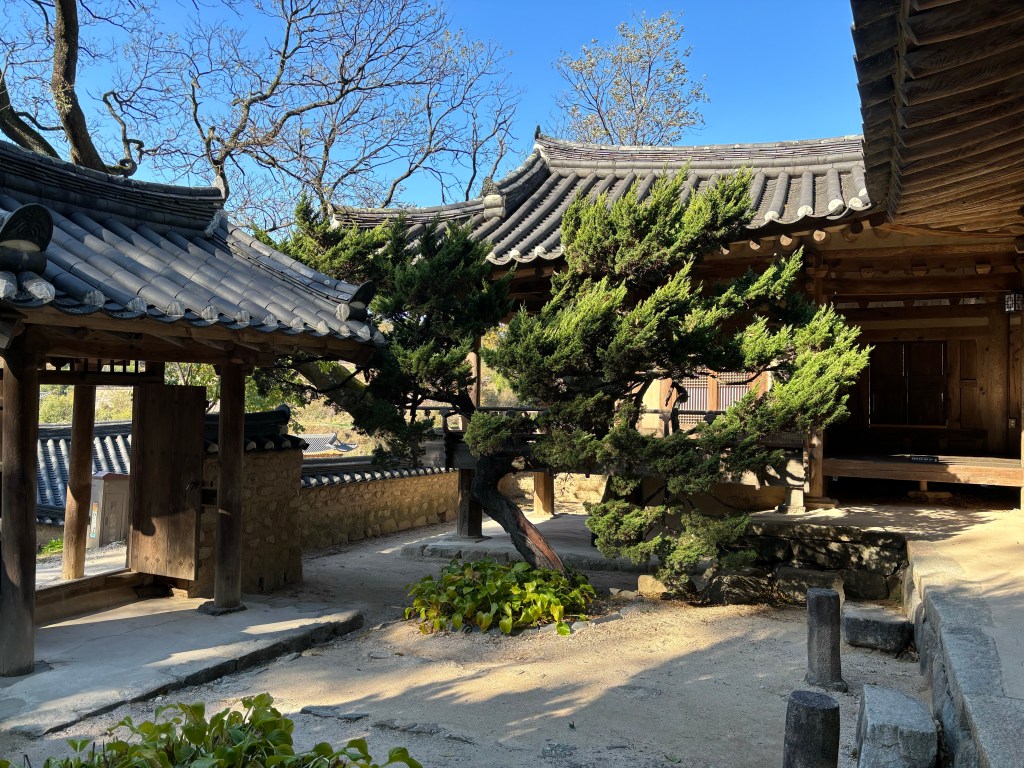
In pleasant weather, the town must make for a delightful half-day trip, with beautiful views, lots of winding paths to discover hidden nooks and crannies, and some houses here and there acting as coffee shops and restaurants. Today, however, it was so bitterly cold that my hands hurt whenever I had to take out the map to find my way. The wind was fierce, blowing gusts of leaves and twigs in waves over the roads, and the sun provided a deceivingly bright backdrop for photos but very little warmth.
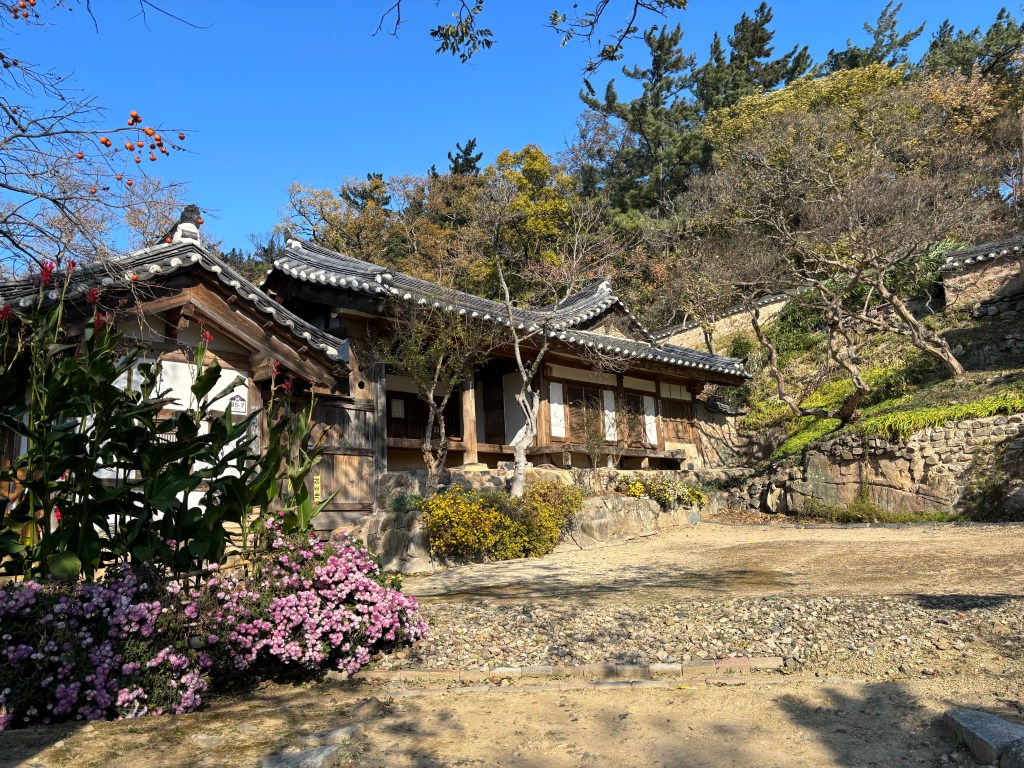
I put some effort in seeking out a couple of notable buildings, but I’d covered less than half the town when I decided to get back: it was far too cold and uncomfortable, and the traditional houses too similar to each other, to warrant spending any more time in the wind. Part of the hurry, too, was that if I made the 12:00 bus I’d be back in Gyeongju for lunch, but if I didn’t I’d have to wait till 14:00.
So I turned right back and got on the bus at noon, which also took less than an hour to tale me and four Korean ladies back to the center of Gyeongju. The main street was absolutely packed with tourists (it is a sunny Saturday), which makes me think these are all day-trippers from Busan who aren’t staying or bothering to step outside of the sightseeing area.
I went straight to a restaurant I’d preselected because I wanted to have dakgalbi, marinated chicken, but only when I sat down inside the traditional house next to the touristy street and was handed an English menu did I realize that I’d misread the Korean menu online: what I thought was dakgalbi (닭갈비) actually read deokgalbi (떡갈비), which is something like a burger? Anyway, that didn’t appeal, so I ordered grilled sole, which came out with its usual accoutrements:
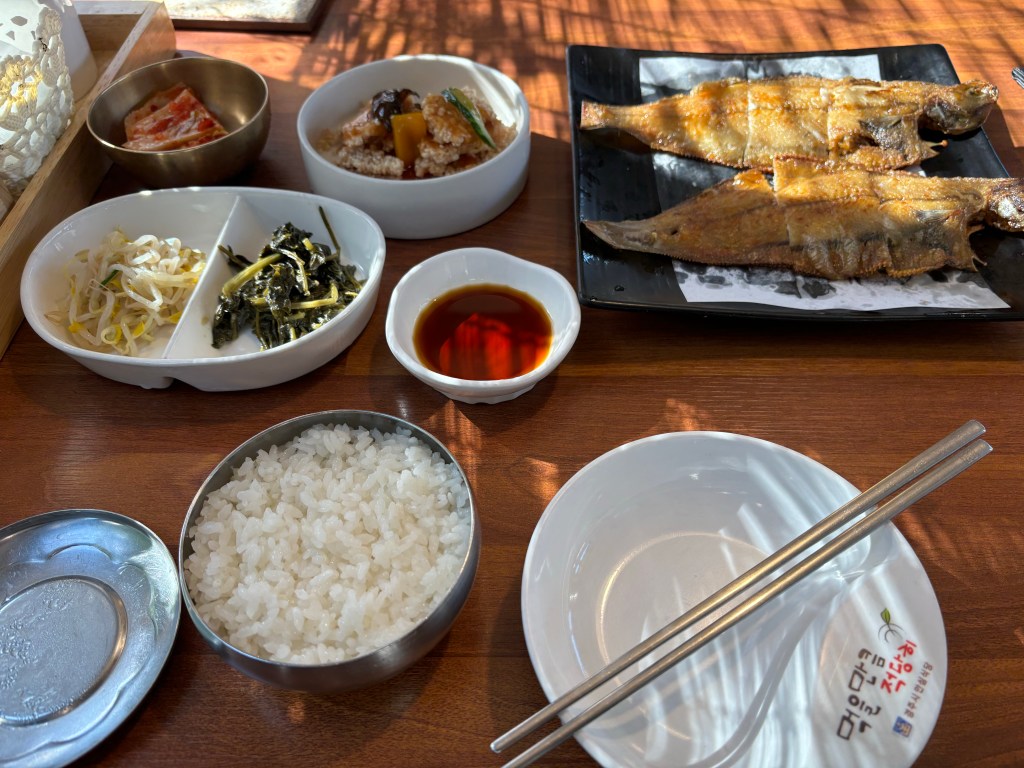
This is my first time having fish in Korea, so this is how I learned that eating an entire fish with chopsticks is… not easy! I had to wield the chopsticks in one hand and the spoon in the other to properly remove the bones. It was so worth it though: the fish was delicious, crispy on the outside, perfectly cooked on the inside. The kimchi: pretty spicy! And that whole meal pictured above, by the way, set me back 11,000 won (just €7.80!).
After lunch, I had the fleeting idea that I could kill the time until nightfall by catching a movie, because yesterday walking downtown I noticed there’s a Lotte Cinema that shows movies in English, but the times didn’t work out. Alas! Instead, I went back to my hotel to rest.

At about five thirty, when it was already getting dark, I left my lair like a vampire and headed across town to see the Cheomseongdae Observatory. At first sight a small stone construction that might as well be another funerary stupa, it is in fact an astronomical observatory from the 7th century! It is believed to be the oldest known observatory in Asia. I don’t know about you, but I never get used to the awe of laying my eyes on an object that has been around for more than a thousand years.
The observatory is not that big, but its peculiar shape and its historical significance have turned it into one of the symbols of Gyeongju, as you might notice from all the souvenirs and promotional signs around town.
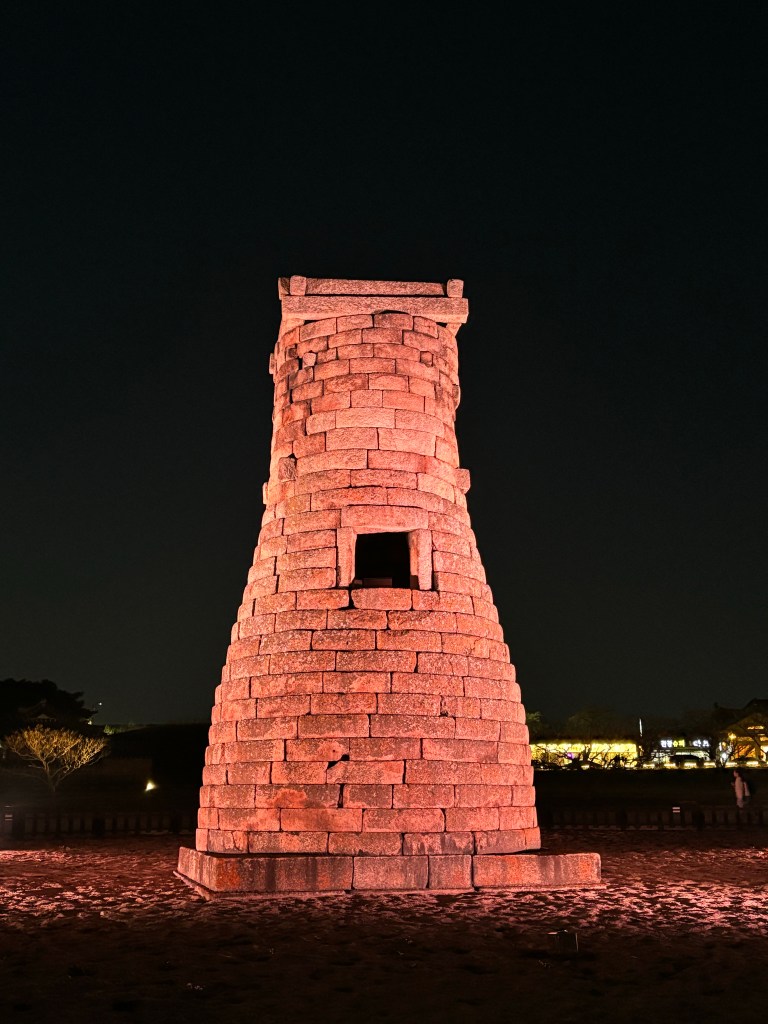
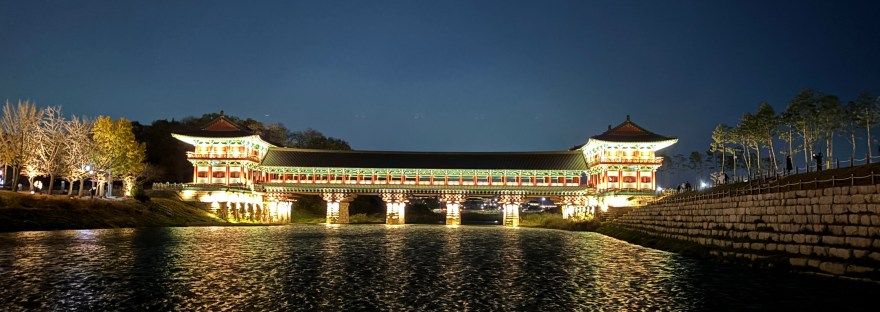
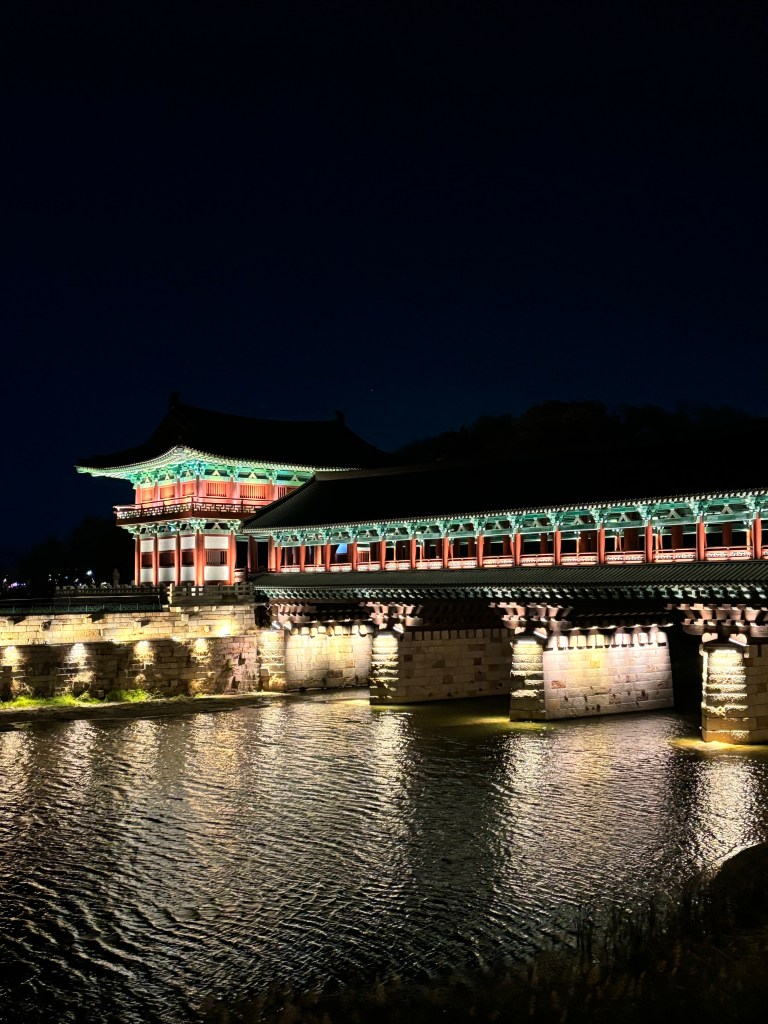
I took a quick look and a couple of pictures -the cold did not invite further reflection- and made the short walk across the park to my next (and primary) goal: Woljeonggyo bridge. Another one of Gyeongju’s famous sights, this traditional Korean bridge is impressive in its own right but becomes spectacular at night, when the lights showcase its vibrant colors and project its reflection onto the water.
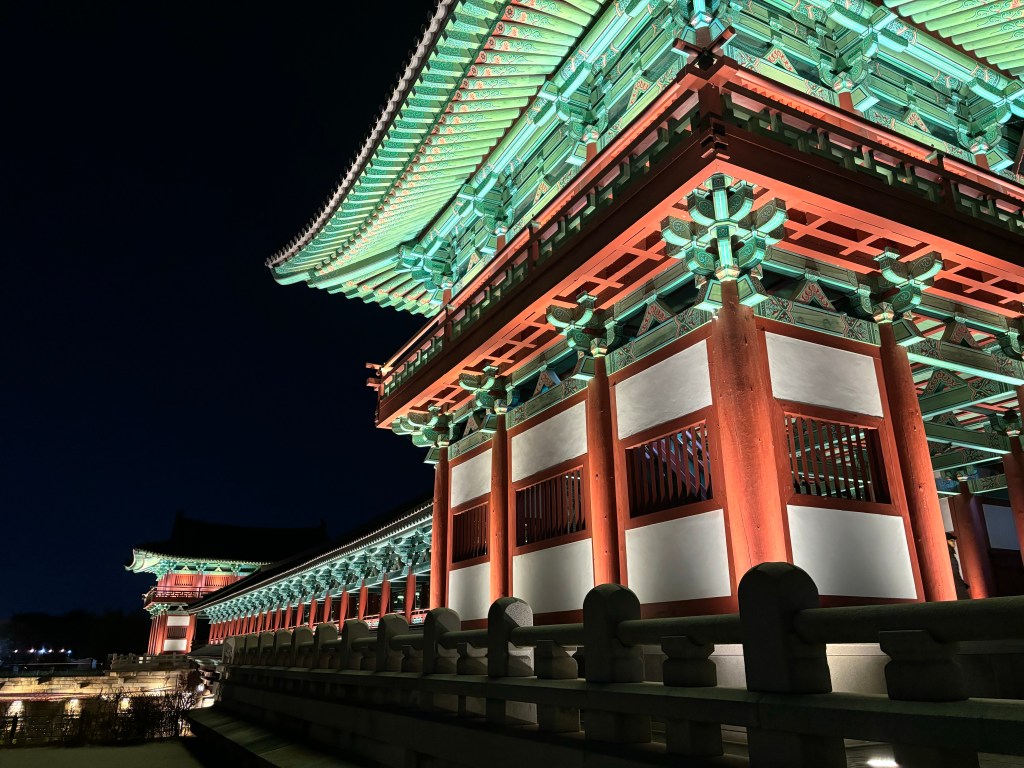
I saw that it is beautiful inside, as I crossed it, but of course the real attraction is to look AT the bridge, not FROM it, so I made my way to a crossing a little bit further down the river made from large stepping stones. Even though there are colored lights on the steps, I don’t think I would have noticed them on my own if I hadn’t been told about them beforehand! Lots of people were crossing the river, to take a perfectly centered picture of the bridge from the middle, but the steps are large enough that I was never too worried about stepping into the no doubt freezing water.
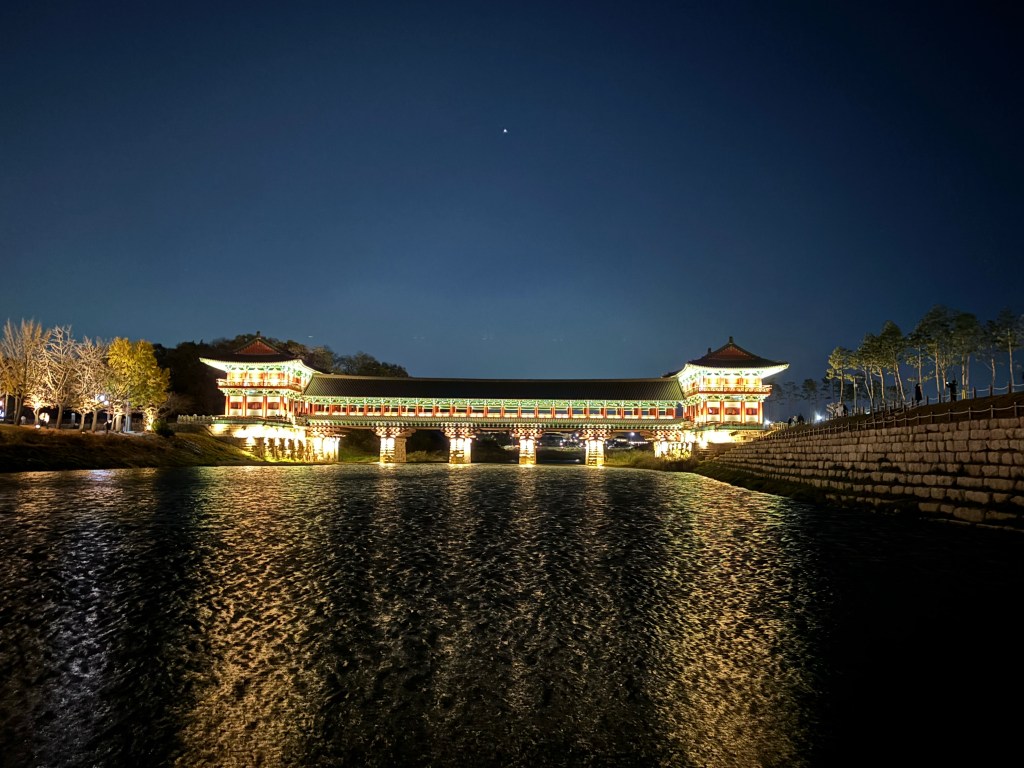
The pavilions and ponds I saw yesterday were beautiful at night, but would have been so during the day too. This bridge is definitely the one sight that it’s really worth seeking out at night, because the bright lights against the black sky and the undulating waters create a magical effect, one of those “I am really here!” moments.
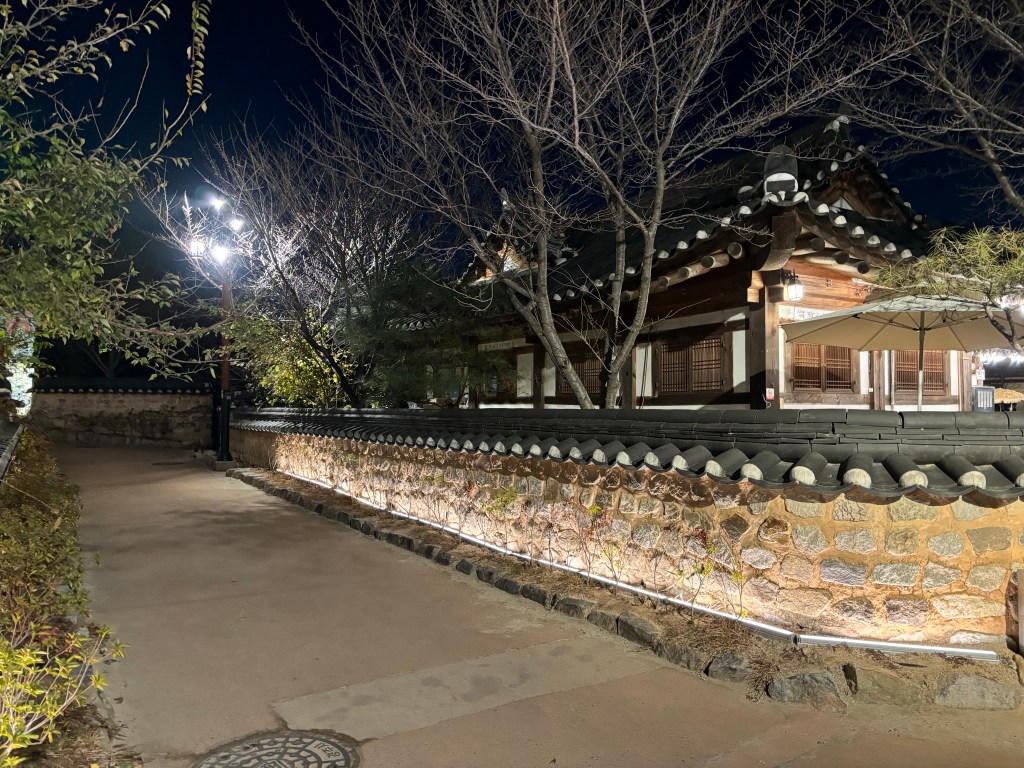
I made my way back northeast, towards the modern city, through a hanok (a neighborhood of traditional houses) that I didn’t know existed: beautiful, elegant houses, all apparently cafes that seemed still open but empty now, at about six thirty in the evening.
I got to see the last item on my Gyeongju list, in my last night in Gyeongju: in the end, I can see that I could have seen the most important sights in one day, but I don’t mind having spent two. I’ve gotten to know this town a little better.
Tomorrow: I’m off to Busan!

 This Is A Lake